Histology
Safety
Histology carries the heaviest chemical burden of any laboratory discipline: formaldehyde at the grossing bench, xylene at the processor and coverslipper, alcohols, acids, silver salts and dye powders on the stain rack. This domain covers how a technologist protects themselves and everyone downstream — protective equipment, engineering controls, safe chemical storage and transport, spill response, decontamination, ergonomics and incident reporting. It is weighted more heavily in histology than in any other field, and the questions reward practical bench judgement rather than memorised rules. Safety is one of the eight competency areas assessed in the Histology Fields-of-Practice examination set by CAMLPR.
Choosing protective equipment that matches the hazard
Histology work exposes the eyes, skin and airway to fixatives, clearing agents and unfixed tissue. Protective equipment is chosen for the specific hazard rather than worn out of habit: a face shield over eye protection whenever formalin is poured or a fresh specimen is opened, a fluid-resistant gown with cuffed sleeves at the grossing bench, and a glove material matched to the chemical being handled. Technologists are expected to inspect equipment before use, remove it in an order that keeps contamination off the skin, and never carry it into clean areas such as the reading room or staff lunch room.
A technologist is about to gross a run of bowel resections submitted in 10% neutral buffered formalin. Fixative will be poured from the bucket and tissue will be cut wet, so splashing toward the face is foreseeable. Which combination of protective equipment suits this task?
The waste and fresh solvent reservoirs on the tissue processor are being changed, a job that involves several minutes of direct contact with xylene and the real chance of hands entering the liquid. Which glove choice gives adequate protection for that contact time?
Hand hygiene and personal habits at a chemical bench
Hand hygiene in histology guards against two things at once: biological material from unfixed specimens and chemical residue from dyes, solvents and fixatives. Gloves are removed without touching their outer surface, and hands are washed whenever they are visibly soiled, whenever chemical contact is suspected, before leaving the department, and before eating. Alcohol rubs are convenient for organisms but do nothing to remove dye or solvent residue from skin. Food, drink, cosmetics and contact lens handling stay out of the technical area entirely, and lab coats stay behind when staff go to the cafeteria.
After decanting working stain solutions at the bench, a technologist removes their gloves and notices a faint colour stain across two fingers. They are due to leave the department for a meeting. Which hand-hygiene step is appropriate before leaving?
Packing and shipping specimens under transport rules
Anything leaving the laboratory by road, rail or air falls under Transportation of Dangerous Goods requirements, and histology ships plenty: fresh tissue to reference centres, blocks and slides for consultation, and bulk formalin or solvent waste. The common case is a diagnostic specimen classified as a Category B biological substance, which travels under triple packaging with a leak-proof primary receptacle, absorbent, a rigid outer box and the diamond marking. Technologists who classify, pack, label or sign shipping documents must hold current training and work to the written procedure rather than improvising with whatever container is at hand.
A fresh muscle biopsy from a patient known to carry hepatitis B is being couriered by road to a specialised neuromuscular laboratory in a neighbouring province. The tissue is a routine diagnostic sample. Which classification and packaging applies to the shipment?
A histology technologist classifies specimens and signs the shipping documents for consultation material sent out by ground courier. During an accreditation walkthrough the assessor asks how long that person's transport training certificate stays valid. What is the correct interval for road transport in Canada?
Using the engineering controls the laboratory provides
Engineering controls do the heavy lifting on chemical exposure in histology, and they only work when used as designed. Grossing is done on a ducted or downdraft station with the specimen inside the capture zone; solvent decanting and dye weighing happen in a fume enclosure with the sash at the marked height; processors, stainers and coverslippers are vented or fitted with carbon filtration that must be changed on schedule. Technologists check airflow indicators before starting, keep hoods free of stored bottles that disturb airflow, and stop work when an alarm or a failed indicator says the control is not performing.
| Station | 8-h TWA formaldehyde (ppm) | Laboratory action limit (ppm) |
|---|---|---|
| Station one | 0.31 | 0.75 |
| Station two | 0.88 | 0.75 |
| Station three | 0.42 | 0.75 |
| Station four | 0.09 | 0.75 |
[TABLE] Personal air monitoring was carried out at four grossing stations during a full working day and the results are compared against the laboratory's own action limit. Which station needs corrective work on its ventilation before grossing continues there?
New staff are being shown how to use a downdraft grossing station so that formaldehyde vapour is drawn away from the breathing zone rather than rising past the face. Where should the cutting board and the specimen be positioned on the work surface?
Storing, labelling and handling chemicals, dyes and stains
Histology stocks an unusually hazardous shelf: flammable xylene and alcohols, corrosive acids used for decalcification, oxidisers, silver salts, mercury-containing fixatives and dry dye powders that become airborne when weighed. Safe practice means storing flammables in an approved cabinet, segregating incompatible classes, keeping picric acid hydrated, and using labelled containers. Every container decanted for workplace use carries a workplace label naming the product, giving safe-handling precautions and pointing to the safety data sheet. Technologists are expected to read the data sheet before first use of a reagent and to know which sections carry exposure limits, spill guidance and disposal requirements.
Xylene is drawn from a bulk drum into a one litre amber bottle that will sit at the coverslipping bench for the remainder of the shift and be used by two technologists. What information must appear on that bottle before it goes into use?
A procedure has been introduced that requires an hour of continuous xylene handling outside a fume enclosure, and the supervisor wants the exposure limit and the respirator requirement confirmed from the safety data sheet before it is approved. Which section holds that information?
Reducing the chance of injury or transmitted infection
The recurring injuries in histology come from blades and from unfixed tissue. Microtome and cryostat knives are treated as live sharps from the moment they leave the dispenser: loaded with the guard in place, covered whenever the operator's hands go near the stage, and discarded into a rigid sharps container rather than a waste bin. The handwheel is locked before blocks are changed or debris is cleared. Fresh, unfixed tissue is handled as potentially infectious throughout, with cutting done to avoid aerosols and splashes, and any known high-risk case flagged so that the appropriate containment is arranged before the specimen arrives.
Paraffin shavings have built up on the microtome stage and around the knife holder, and the technologist wants to clear them before mounting the next block in the chuck. What should be done first?
Decontaminating benches, cryostats and instruments
Disinfection in histology has to account for surfaces that are cold, oily with paraffin, or coated in dried reagent, none of which behave like a clean bench top. Cryostats used for unfixed tissue are defrosted, cleared of section debris and disinfected at room temperature, because chemical disinfectants are unreliable at cryostat operating temperatures. Blood spills are treated with a suitable chlorine-releasing agent at the concentration the laboratory validates, and prion-suspect work follows a separate, far more aggressive protocol. Technologists follow the manufacturer's compatibility guidance so that a disinfectant does not corrode optics, cutting stages or instrument housings.
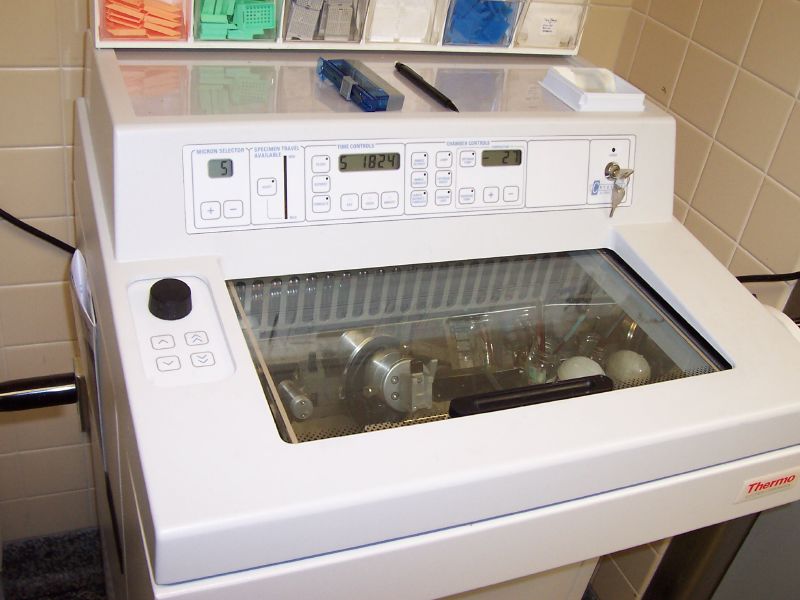
[IMAGE] Unfixed lymph node has been sectioned in the cryostat shown for an urgent intra-operative case, leaving tissue debris in the chamber. The instrument must now be decontaminated. What condition has to be met for the disinfectant to be effective?
Reacting to exposures, injuries and chemical emergencies
The value of emergency equipment lies in reaching it quickly and using it long enough. A chemical splash to the eye means fifteen minutes at the eyewash with the eyelids held open, followed by medical assessment; skin contact means the safety shower and removal of contaminated clothing while the water runs. Aisles to that equipment stay clear and the units are flushed on a schedule. For fire, unexpected vapour release or a container found in a degraded state, the response is to alert others, restrict access and escalate rather than to attempt a fix. Technologists know their evacuation route and their alarm points before an incident happens.
Formalin is being poured from a carboy into specimen buckets when a splash gets past the technologist's safety glasses and into the right eye. The eyewash station is three metres away and the eye is stinging badly. What is the immediate action?
During a stock-room audit a technologist finds an old bottle of picric acid with dry yellow crystals encrusted around the cap threads and shoulder of the container. Nobody recalls when it was last opened. What is the correct response?
Containing and cleaning up chemical and biological spills
Every histology laboratory keeps a formaldehyde spill kit and a solvent spill kit, and staff need to know which one to open and where the line sits between a spill they may clean and one that triggers evacuation. Small formalin spills are covered with a neutralising or absorbing agent applied from the perimeter toward the middle, so the puddle is not pushed outward, then swept up and treated as hazardous waste. Solvent spills demand ignition sources off and ventilation increased before anything else. Large volumes, unknown chemicals or a spill in a poorly ventilated space mean evacuate, restrict entry and call for help.
About 300 mL of 10% neutral buffered formalin is knocked over on a grossing bench. The staff present are trained, the room is ventilated and the formaldehyde spill kit is on the wall behind them. In which direction should the neutralising absorbent be applied to the puddle?
A one litre bottle of xylene shatters on the floor beside the tissue processor. The liquid is spreading across the tiles, staff are still working in the room and the processor is mid-cycle. What must happen before absorbent is placed on the spill?
Writing up incidents, exposures and near misses
Reporting exists so that the same event does not happen to the next person, which is why near misses are documented as carefully as injuries. A technologist completes the occurrence report during the shift in which the event happened, describing what occurred, what was being done at the time, the chemical or agent involved and any equipment that failed. Exposures are also reported to the supervisor and to occupational health so that follow-up such as serology or medical assessment is arranged. The report belongs in the laboratory's safety record and is reviewed for trends; it never goes into the patient's chart.
While clearing the bench a technologist's glove is torn by a used microtome blade that had been left uncovered. The skin underneath is intact, nobody is hurt and the blade is discarded correctly afterwards. What documentation does this event require?
Setting up the bench to prevent repetitive strain
Microtomy is among the most repetitive tasks in the laboratory: hours of one-handed wheel rotation with the neck flexed over the block, followed by microscope work and embedding at a hot plate. Poor set-up produces shoulder, wrist and neck injuries that end careers. The workstation is adjusted so the handwheel sits near elbow height with the forearm supported, the chair gives lumbar support with the feet flat or on a rest, and the microscope eyepieces come up to the eyes rather than the head coming down. Technologists rotate tasks, take short breaks and report early symptoms instead of working through them.
A technologist who cuts blocks for three to four hours most mornings reports aching in the right shoulder and wrist that eases overnight and returns by mid-morning. Which adjustment to the microtomy workstation best addresses the strain?
Speaking up when something at the bench is unsafe
Safety systems in Canadian laboratories rely on the people doing the work raising problems early. A technologist who notices a failing fume hood, a missing guard, a chemical stored beside something incompatible, an empty eyewash or a colleague working without protection is expected to act: stop the unsafe task, make the hazard visible by tagging equipment out of service, and tell the supervisor or the joint health and safety committee so it is logged and fixed. Workers also hold the right to refuse work they reasonably believe is dangerous. Concerns are raised through the process rather than worked around quietly.
The airflow alarm on the ducted grossing station sounds intermittently through the morning and the sash indicator is reading below its marked range. A large resection is waiting to be cut and the surgeon has asked when the report will be ready. What should the technologist do?
Back to all histology areas in the Histology study guide.
MLTPrep is an independent study resource. Not affiliated with or endorsed by CAMLPR. Always confirm current requirements with CAMLPR directly.