Clinical Chemistry
Safety
Safety in the chemistry laboratory is not a separate task added on top of the work — it is how the work is done. This domain covers protecting yourself and everyone around you from biological, chemical, physical and ergonomic hazards: what you wear, how you handle reagents and specimens, how you decontaminate, and what you do in the first minutes when something goes wrong. It also covers the part that outlives the incident — reporting it clearly enough that the next technologist is not hurt the same way. Safety is one of the eight competency areas assessed in the Clinical Chemistry Fields-of-Practice examination set by CAMLPR.
Choosing, wearing and removing protective equipment
Protective equipment only protects when it matches the hazard and comes off in the right order. You are expected to judge each task — closed-tube analysis, manual aliquoting, decanting acid waste — and select gloves, a fluid-resistant coat, eye protection and a face shield accordingly. Gloves are changed between tasks and never worn out of the work area or used to touch keyboards, telephones and door handles. Removal matters as much as selection: the most contaminated item comes off first, hand hygiene follows, and single-use items go straight into the correct waste stream.
A technologist is about to decant concentrated acidic analyser waste from a 4 L carboy into a smaller container at an open bench. The pour is done at arm's length and splashing is likely. Beyond a fluid-resistant lab coat and chemical-resistant gloves, what is the minimum eye and face protection for this task?
After working in a splash-prone processing area, a technologist is leaving the bench wearing gloves, a fluid-resistant gown, a face shield and a mask. The gloves are visibly contaminated with blood. Which item is removed first?
Hand hygiene at the bench
Hand hygiene is the single most effective barrier between a contaminated bench and everything you touch afterwards. In practice that means cleaning your hands before gloving, immediately after gloves come off, between patients during collection, after handling any specimen container, and before leaving the laboratory. Alcohol-based rub is the routine choice when hands are not visibly soiled; soap and running water is required when hands are dirty, after a spill clean-up, and after any contact with spore-forming organisms, which alcohol does not kill. Knowing which of the two a situation demands is the examinable point.
A technologist's hands are not visibly soiled. The task just completed was receiving and logging a stool container from a patient with confirmed Clostridioides difficile infection, which was handled with gloves. Which hand hygiene action is required immediately after those gloves are removed?
Packaging and shipping specimens as regulated goods
Specimens leaving the laboratory become regulated shipments. You are expected to classify the material correctly — most diagnostic specimens travel as UN3373 Biological Substance, Category B, while cultures of high-risk pathogens travel as UN2814 — and to build the triple package that classification requires: a leakproof primary receptacle, a leakproof secondary container with enough absorbent to take up the entire volume, and a rigid labelled outer box. Dry ice, formalin and flammable fixatives carry classifications of their own. Anyone who prepares, offers or signs for such a shipment must hold current training.
A serum specimen from a patient with suspected hepatitis B infection is being couriered to a reference centre for confirmatory testing. It is a routine diagnostic specimen, and nothing about the request suggests a Category A agent. How should it be classified and packaged for transport?
A technologist has been assigned to prepare dangerous goods shipments and hand them to the courier at the end of each day, which includes signing the shipping documentation. What must be in place before that technologist may sign?
Engineering controls and built-in safety devices
Engineering controls remove a hazard at its source instead of relying on the technologist to behave perfectly every time. On a chemistry bench they include biological safety cabinets and fume hoods, splash shields, sealed centrifuge rotors and buckets, closed-tube sampling on analysers, retractable lancets and needles, point-of-use sharps containers, and eyewash stations and emergency showers. You are expected to use these devices exactly as designed — grilles unobstructed, sashes at the marked working height, safety features activated every single time — and to recognize when a control has been defeated, disabled or is overdue for certification.
The Class II Type A2 cabinet on your bench is in routine use. During a busy shift a technologist stacks absorbent pads and a small discard container along the front edge of the work surface, covering the front intake grille. What is the immediate consequence for the operator?
A capillary collection area still uses non-retracting lancets, and two staff have sustained skin punctures in six months while discarding them. The safety committee wants a change that sits as high as possible in the hierarchy of controls. Which option is an engineering control?
Handling, labelling and storing chemicals and reagents
Every chemical in the laboratory arrives with a supplier label and a safety data sheet, and both must stay accessible to bench staff. You are expected to read the pictograms, label working solutions and stains with identity, hazard and date, store containers by compatibility rather than alphabetically, keep oxidizers away from flammables and acids away from bases, and use a fume hood for anything volatile or corrosive. Keep the smallest workable quantity at the bench, use secondary containment for large bottles, and discard expired or degraded reagents through the hazardous waste stream rather than the sink.
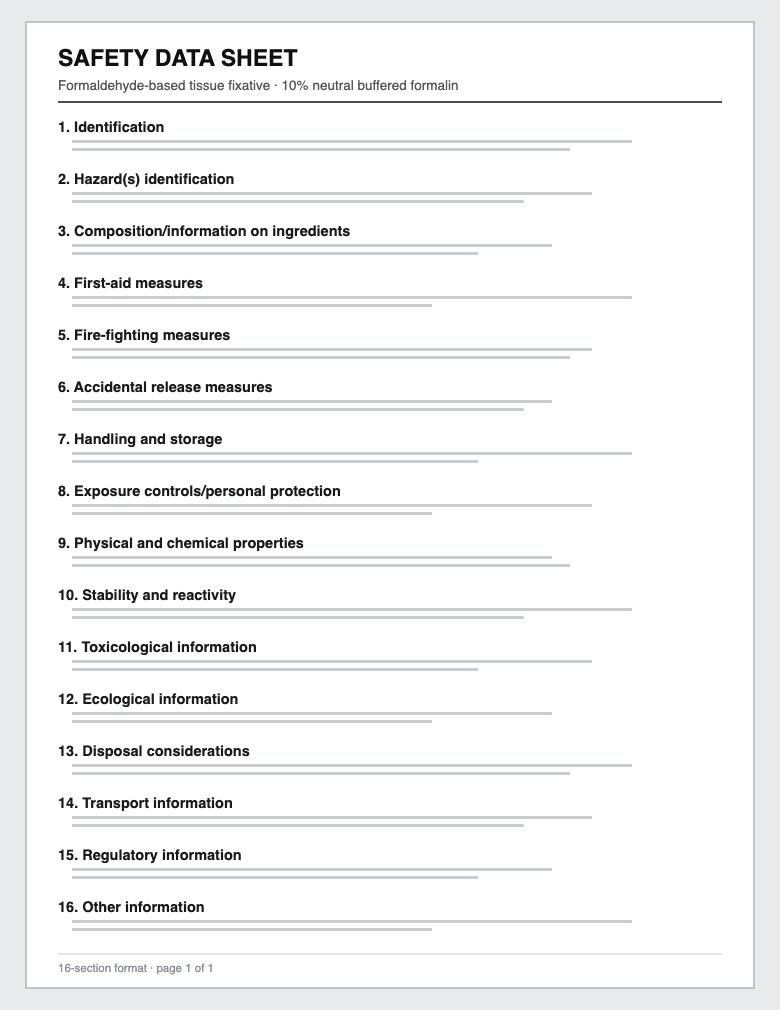
The photograph shows the standardized safety data sheet supplied with a formaldehyde-based fixative that has just been delivered to the bench. Before the product is put into use, a technologist must decide which absorbent and neutralizing agent to stock for a possible spill. Which numbered section supplies that information?
A 2.5 L bottle of concentrated nitric acid arrives in the chemistry laboratory. The corrosives cabinet currently holds hydrochloric acid, glacial acetic acid and a shelf of absolute methanol kept there for a manual method. Where should the nitric acid be placed?
Reducing the chance of exposure during routine work
Most laboratory exposures happen during ordinary, unremarkable steps: uncapping tubes, aliquoting, recapping needles, reaching into a centrifuge too soon. This area asks you to design those steps so an exposure cannot easily occur — uncap behind a shield or inside a cabinet, never recap a needle by hand, let rotors stop fully before opening the lid, transport specimens in sealed leakproof bags, cover any break in the skin with an occlusive dressing, and keep food, drink and cosmetics out of the work area entirely. Immunization status, particularly hepatitis B, belongs to the same protective picture.
A technologist must remove rubber stoppers from a rack of clotted blood tubes before aliquoting them manually for a send-out panel. Which practice most directly reduces droplet and aerosol exposure during the uncapping step?
Disinfecting benches and decontaminating equipment
Disinfection reduces the microbial load on a surface; sterilization destroys everything present, spores included. You are expected to know which one a job needs, choose an agent with proven activity against the organisms involved, and give it the contact time the manufacturer specifies — a disinfectant wiped straight off has not worked. Benches are decontaminated at the start and end of every shift and after any spill, with freshly diluted sodium hypochlorite the usual choice for blood. Equipment leaving for repair must be decontaminated and certified, and autoclave loads verified with biological indicators, not tape alone.
A small blood spill on a chemistry bench has been absorbed and the soaked material discarded. The exposed surface must now be disinfected with sodium hypochlorite. Which combination of dilution and contact time is appropriate?
A laboratory autoclaves contaminated glassware in-house before it is washed and reused. The quality manager asks which routine check provides the strongest evidence that a particular load actually achieved sterilization. Which is it?
Acting in the first minutes of a safety incident
When something goes wrong the first minutes decide the outcome, so the response has to be automatic. Chemical in the eye means fifteen minutes at the eyewash before anything else, notification included. A sharps injury means washing the site and reporting immediately so post-exposure assessment starts inside the window where it still helps. Fire means rescue, alarm, contain, then extinguish or evacuate, with the agent matched to the fuel. You are expected to know where the eyewash, drench shower, alarm pull, extinguishers and gas and power shut-offs are without looking, and to escalate rather than manage alone.
While working at an open bench a technologist splashes a strongly alkaline reagent into one eye. Another technologist is present and the eyewash station is two metres away. What must happen first?
A small fire breaks out inside the electrical housing of a chemistry analyser that is still energized, and the area is being evacuated. Which extinguisher is appropriate?
Containing and clearing a spill
A spill is contained before it is cleaned. Alert the people nearby, restrict access to the area, put on the protection the material demands, then work from the outer edge inwards using the absorbent supplied in the kit. Biological spills are covered, absorbed and then disinfected with an appropriate agent for its full contact time; broken glass is lifted only with forceps, tongs or a scoop and goes to a sharps container. Chemical spills are matched to the correct absorbent or neutralizer, and anything large, volatile or unidentified is a call for help rather than a mop.
Roughly 300 mL of concentrated acid reagent is spilled on the floor beside a chemistry analyser in a busy, ventilated area. A chemical spill kit is available and the material is identified. What is the correct opening sequence?
A tube of whole blood is dropped and shatters on the laboratory floor, leaving liquid blood with glass fragments in it. The spill has been contained and the disinfection step is about to begin. How are the glass fragments removed?
Writing up an incident so it can be acted on
An incident that is not written down cannot be prevented from happening again. You are expected to report exposures, spills, near misses and unsafe conditions promptly through the laboratory's system, and to know what the report must contain: date and time, the exact task and device in use, the material and volume involved, who was affected, what was done immediately, and any witnesses. Near misses are reported even though nobody was hurt. These reports feed occupational health follow-up, root cause review and trend analysis, so speculation about blame belongs nowhere in them.
A technologist sustains a needlestick from a used blood collection needle, receives immediate care and returns to the bench. The incident report is now being completed. Which entry is most useful for preventing a recurrence?
Working without injuring yourself over time
Laboratory work is repetitive, and the injuries it causes accumulate quietly over years. This area covers arranging the workstation so the body stays neutral: chair and bench heights set so the shoulders drop and the forearms rest level, microscope eyepieces raised to the eyes rather than the neck bent down to them, frequently used items kept inside easy reach, wrist support during keyboard work, and anti-fatigue matting where standing is prolonged. Rotating tasks, taking short breaks, using electronic or low-force pipettes, and asking for help to lift reagent cubes and waste containers are expected rather than optional.
A technologist performs long uninterrupted runs of manual pipetting each morning and now reports aching in the thumb and forearm that eases overnight and returns by mid-shift. Which change addresses the underlying ergonomic cause rather than the symptom?
Routine practices and additional precautions
Routine practices apply to every specimen from every patient, because infection status is often unknown at the time of collection. Layered on that baseline, additional precautions — contact, droplet or airborne — apply to named patients and mainly govern collection at the bedside rather than testing at the bench, since an intact bagged tube is handled under routine practices once it reaches the laboratory. You are expected to gown, glove and mask according to the sign on the door, perform hand hygiene at the right moments, bag the specimen before leaving the room, and doff protection in the correct sequence.
A serum tube arrives in the chemistry laboratory from a patient placed on droplet precautions for influenza. The tube is intact, correctly bagged and the requisition is clean. Which precautions apply to the technologist who centrifuges and loads it?
A phlebotomist collects blood from a patient in a room under contact precautions, wearing a gown and gloves. The draw is complete and the tubes must now travel to the laboratory. What is the correct way to move them?
Raising a hazard before it causes harm
Safety depends on people saying something early. This area asks you to notice hazards — a silenced alarm, a frayed cord, an overfilled sharps container, a defeated interlock, a colleague working without eye protection — and to act on them rather than work around them. That means stopping the unsafe activity where the risk is immediate, tagging equipment out of service, telling the supervisor or safety officer, and entering it in the reporting system so it reaches the safety committee. Speaking up about a colleague's practice is part of the professional duty, not a breach of collegiality.
A technologist finds that the airflow alarm on the solvent fume hood has been silenced and a note taped over the panel reads, known fault, ignore. Solvent extractions are still being run at that hood on every shift. What should the technologist do?
Back to all clinical chemistry areas in the Clinical Chemistry study guide.
MLTPrep is an independent study resource. Not affiliated with or endorsed by CAMLPR. Always confirm current requirements with CAMLPR directly.