Clinical Chemistry
Specimen Collection
Everything a chemistry analyser reports depends on what happened before the tube reached it. This domain covers the whole pre-analytical chain — preparing and identifying the patient, judging whether a request and a specimen belong together, drawing and labelling correctly, and moving the tube through transport and processing fast enough that the analyte is still telling the truth. More reportable errors originate here than anywhere else in the laboratory, which is why it carries fifteen per cent of the examination. Specimen Collection is one of the eight competency areas assessed in the Clinical Chemistry Fields-of-Practice examination set by CAMLPR.
Telling the patient what the test needs
Many chemistry results are only interpretable if the patient prepared correctly, so the technologist has to turn a test requirement into instructions an ordinary person can follow. That covers how long to fast, whether water and regular medications are permitted, timing relative to a drug dose or to waking, and the mechanics of a timed urine collection — which void to discard, where the container is kept, and what to do if one is missed. Give the instruction in plain language, back it up in writing where the laboratory has a handout, and confirm the patient can repeat it back before they leave.
An outpatient will start a timed 24-hour urine specimen tomorrow so that creatinine clearance can be calculated, and asks how to begin. Which instruction should the technologist give?
A patient telephones the day before a fasting glucose and lipid panel and asks what fasting actually means. What should the technologist tell them?
Recognizing a request that should be questioned
Not every requisition that reaches the bench should be run. The technologist screens for orders that duplicate a recent result inside the minimum retest interval, for assays that have been retired in favour of a better marker, for tests the laboratory does not perform on that specimen type, and for requests that cannot answer the clinical question being asked. The response is rarely a silent cancellation. Hold the request, check it against laboratory policy, and speak to the ordering clinician or the reference laboratory before either running or refusing it, then document what was agreed.
A requisition asks for a haemoglobin A1c on an inpatient whose A1c was measured eleven days ago and reported as 7.5%. What is the appropriate first action?
A requisition for suspected acute pancreatitis orders both serum amylase and serum lipase. Laboratory policy states that only one enzyme is performed for this indication. Which action follows the policy?
Reading the requisition against what actually arrived
Accessioning is a deliberate comparison, not a formality. The technologist checks that the surname, given name, date of birth and health number on the tube match the requisition character for character, that the collection date and time agree, that the tube types present can support every test ordered, and that the fill volume is adequate. Any mismatch is treated as an identity failure. Never relabel a tube to make it agree with the paperwork or amend the paperwork to agree with the tube — contact the collector, arrange a fresh specimen where the discrepancy touches identity, and record the event.
A tube arrives labelled J. Martin, DOB 1962-03-04, while the accompanying requisition reads J. Martin, DOB 1962-04-03. What should the technologist do?
A requisition lists sodium, potassium and chloride, but the only tube received with it is a lavender-topped EDTA tube. What is the correct action?
Judging whether the sample can give a valid result
Before anything is loaded, the technologist looks at the specimen itself and decides whether it can support the assay. Haemolysis, icterus and lipaemia all interfere optically and chemically; clots in an anticoagulated tube, gross underfill, the wrong anticoagulant, a broken cold chain or a transport delay all corrupt specific analytes. The judgement is analyte-specific rather than blanket — a haemolysed tube may still be fine for sodium but useless for potassium or lactate dehydrogenase. Where a result is released despite a defect, the interference must be flagged clearly on the report.
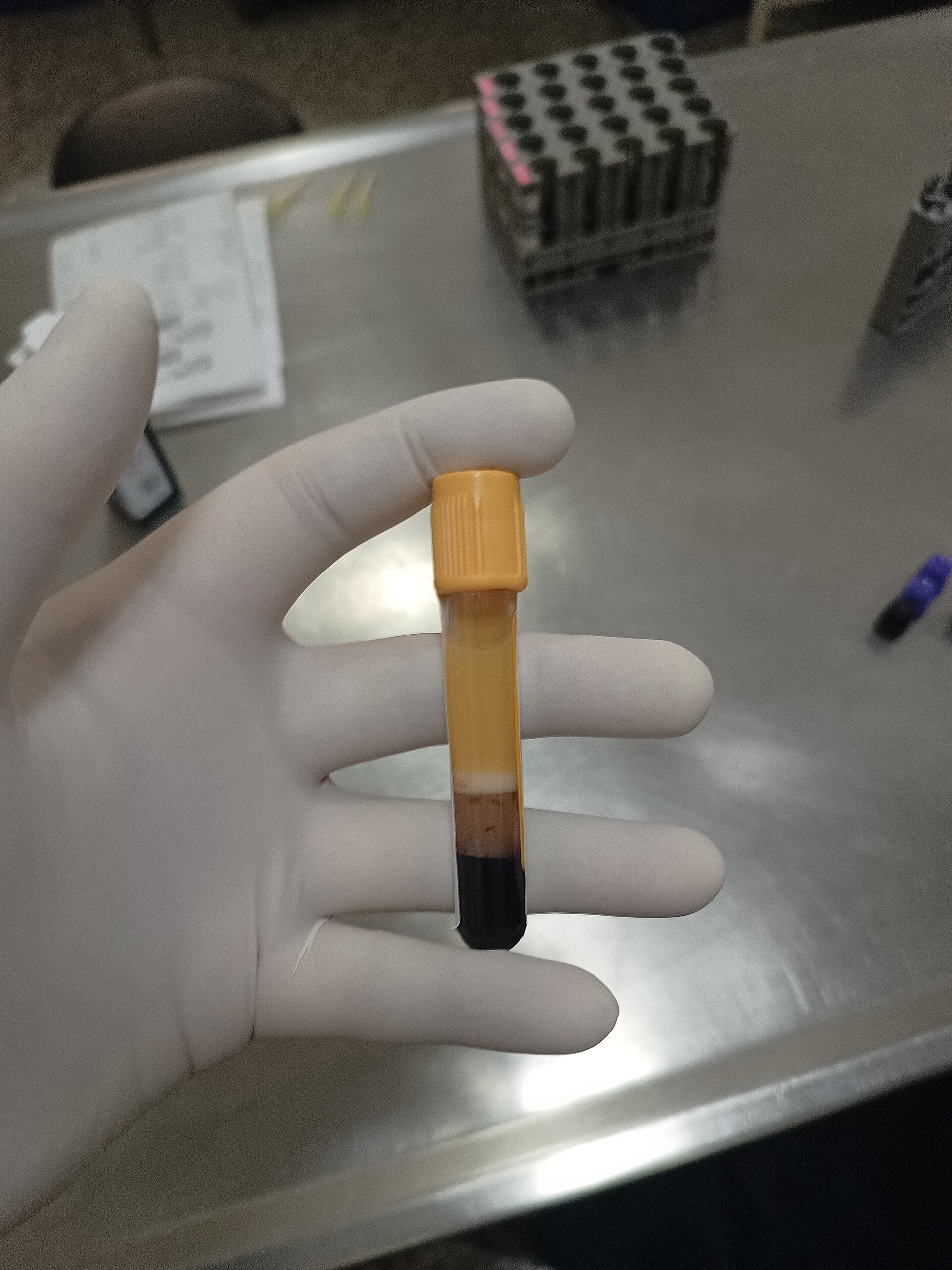
The centrifuged gel tube shown was collected from an inpatient while a parenteral nutrition infusion was running through the same arm. What should the technologist do first with this specimen?
Serum separated from a difficult venepuncture is distinctly red-tinged. Which analyte is most likely to be falsely elevated?
Keeping an unbroken paper trail for legal specimens
Some specimens may end up as evidence — workplace and roadside drug screens, blood alcohol, parentage testing, and samples taken in a suspected assault. For these, the laboratory must be able to prove that the sealed container examined at the bench is the one taken from that patient, and that nobody unaccounted for handled it in between. Tamper-evident seals, a custody form signed and dated at every transfer, secure locked storage, and restricted access are all mandatory. A broken seal, a gap in signatures, or an unwitnessed transfer breaks the chain and the specimen is no longer defensible.
A urine specimen for workplace drug testing arrives with its tamper-evident seal split and the custody form unsigned by the collector. What should the technologist do?
Entering the specimen accurately into the LIS
The laboratory information system record is what every downstream user relies on, so accessioning has to be complete as well as fast. The technologist enters or verifies the accession number, the specimen type and site, the true collection date and time, the collector's identifier, the priority assigned, and any comment about integrity such as haemolysis or a transport delay. Collection time matters more than most fields: therapeutic drug levels, cortisol, and timed collections are uninterpretable without it. Corrections after the fact are made through the system's amendment function so the audit trail survives, never by overwriting silently.
A technologist is accessioning a timed morning cortisol drawn on the ward. Which detail is most important to capture in the laboratory information system?
Deciding which specimen moves first
Transport is a triage decision made under time pressure. Two things drive it: how urgently the clinician needs the answer, and how quickly the analyte degrades once it leaves the patient. Blood gases, ammonia, lactate, ionised calcium and homocysteine deteriorate within minutes and need immediate hand delivery, often chilled; critical care and emergency work outranks scheduled clinic work regardless of analyte. The technologist also has to know which specimens must never travel by pneumatic tube because agitation causes haemolysis, and must ensure cold-chain specimens actually stay cold in transit rather than merely starting that way.
Four specimens are sitting ready for transport at the same moment. Which should reach the laboratory first?
A ward telephones to say a plasma ammonia has just been collected on an encephalopathic patient. What transport instruction should the technologist give?
Deciding what gets processed first at the bench
Once specimens arrive together, processing order is its own decision. Some analytes have hard separation windows: whole blood left on the cells drives potassium up, glucose falls by several per cent an hour without a glycolytic inhibitor, and ACTH needs chilled centrifugation and prompt freezing, while renin is handled at room temperature because chilling cryoactivates prorenin and falsely raises the result. Others are stable for hours and can safely wait. The technologist sorts by stability rather than by arrival order, centrifuges and separates the time-critical tubes first, aliquots into the correct container, and freezes anything destined for a referral laboratory before turning to the routine workload.
Several tubes arrive together at the end of a busy afternoon and cannot all be handled at once. Which should be centrifuged and separated first?
Spotting when the collection itself went wrong
Some results are analytically perfect and still wrong, because the specimen never represented the patient. Classic patterns are recognisable: a wildly high glucose with a high potassium points to a draw above a running infusion; a high potassium with a low calcium and an unmeasurable alkaline phosphatase points to EDTA carryover from tube-order error; a whole panel that shifts implausibly in hours points to a specimen drawn from the wrong patient. The technologist compares against previous results, applies delta checks, asks the collector what happened, and holds the report until the discrepancy is explained.
A potassium of 6.9 mmol/L and a glucose of 42 mmol/L are returned on an inpatient whose results yesterday were unremarkable. The nurse confirms the arm carried a dextrose and potassium infusion. What is the most likely explanation?
A creatinine returns at 310 µmol/L on a patient whose value four hours earlier was 78 µmol/L, with no clinical change reported by the ward. What should the technologist do before releasing it?
Confirming you have the right patient
Two independent identifiers are the minimum, and they must be obtained actively. Ask an alert patient to state their full name and date of birth rather than offering a name for them to agree with, then check what they said against the wristband and the requisition. Bed numbers, room numbers and the name on a chart hanging at the foot of the bed are not patient identifiers. Where the patient cannot answer — unconscious, confused, an infant, or unidentified on arrival — the wristband or the assigned temporary number becomes the reference. Tubes are labelled at the bedside, never afterwards.
A technologist is at the bedside of an alert inpatient. The patient states a name and birth date without being prompted from the label. What must the technologist do next?
An unconscious trauma patient arrives without documents and is registered under a temporary identification number. How should the specimens be labelled?
Performing the draw itself
The technical collection carries its own set of controls. Choose a site clear of infusions, fistulas, haematoma and the side of a mastectomy; disinfect and let the skin dry fully so alcohol does not haemolyse the sample or contaminate an alcohol level. Keep the tourniquet under a minute to avoid venostasis. Follow the order of draw so additives do not carry over between tubes, invert each tube gently the specified number of times immediately after filling, and label at the bedside before leaving the patient. Sharps go straight into the container at the point of use.
A patient needs a blood culture set, a coagulation screen and a serum chemistry profile from a single venepuncture. Which order of draw should be used?
A difficult venepuncture takes several minutes with the tourniquet left in place throughout. Which result is most likely to be affected?
Back to all clinical chemistry areas in the Clinical Chemistry study guide.
MLTPrep is an independent study resource. Not affiliated with or endorsed by CAMLPR. Always confirm current requirements with CAMLPR directly.