Clinical Chemistry
Reporting and Communication
This domain covers everything that happens to a result once the analyser has finished with it: how it is written down, who it goes to, how fast it gets there, and what record survives afterwards. It also covers the observations you make along the way — the lipaemic serum, the short-draw, the reagent bubble — and the referrals you make when a specimen needs work your centre cannot do. A technically perfect result that reaches the wrong person, arrives too late, or leaves no audit trail has failed the patient just as surely as a wrong number would. Reporting and Communication is one of the eight competency areas assessed in the Clinical Chemistry Fields-of-Practice examination set by CAMLPR.
Building the permanent record of results and conversations
Every value you release and every conversation you have about it becomes part of the patient's laboratory record, and in Canada that record is discoverable, auditable and long-lived. You are expected to enter results into the laboratory information system accurately, attach any comment that changes how the number should be read, and capture telephoned or verbal communications with the same rigour — who you spoke to, when, what you said, and their read-back. Corrections are amendments, never erasures: the superseded value stays visible with a reason and a timestamp so that anyone reviewing the chart later can reconstruct exactly what the clinician knew and when.
A technologist telephones a potassium of 6.9 mmol/L to the ward and speaks to the patient's registered nurse, who repeats the value back correctly. What must now be entered in the laboratory record?
A creatinine reported four hours ago is found to have been run on the wrong aliquot. The correct value is substantially different and the report has already reached the ordering physician. How should the laboratory record be handled?
Recording what you observe while the work is in progress
Results do not arrive out of nowhere; they come out of a specimen and an instrument, and both can misbehave in ways the printed number does not show. You are expected to note what you see as you see it — turbid or icteric serum, a partial fill, a fibrin strand, a drifting baseline, an aspiration alarm, a reagent lot swapped mid-run. These notes go into the run record or maintenance log at the time, with a timestamp and what you did about it, not reconstructed at shift end. When a result is later questioned, contemporaneous observations are usually the only thing that explains it.
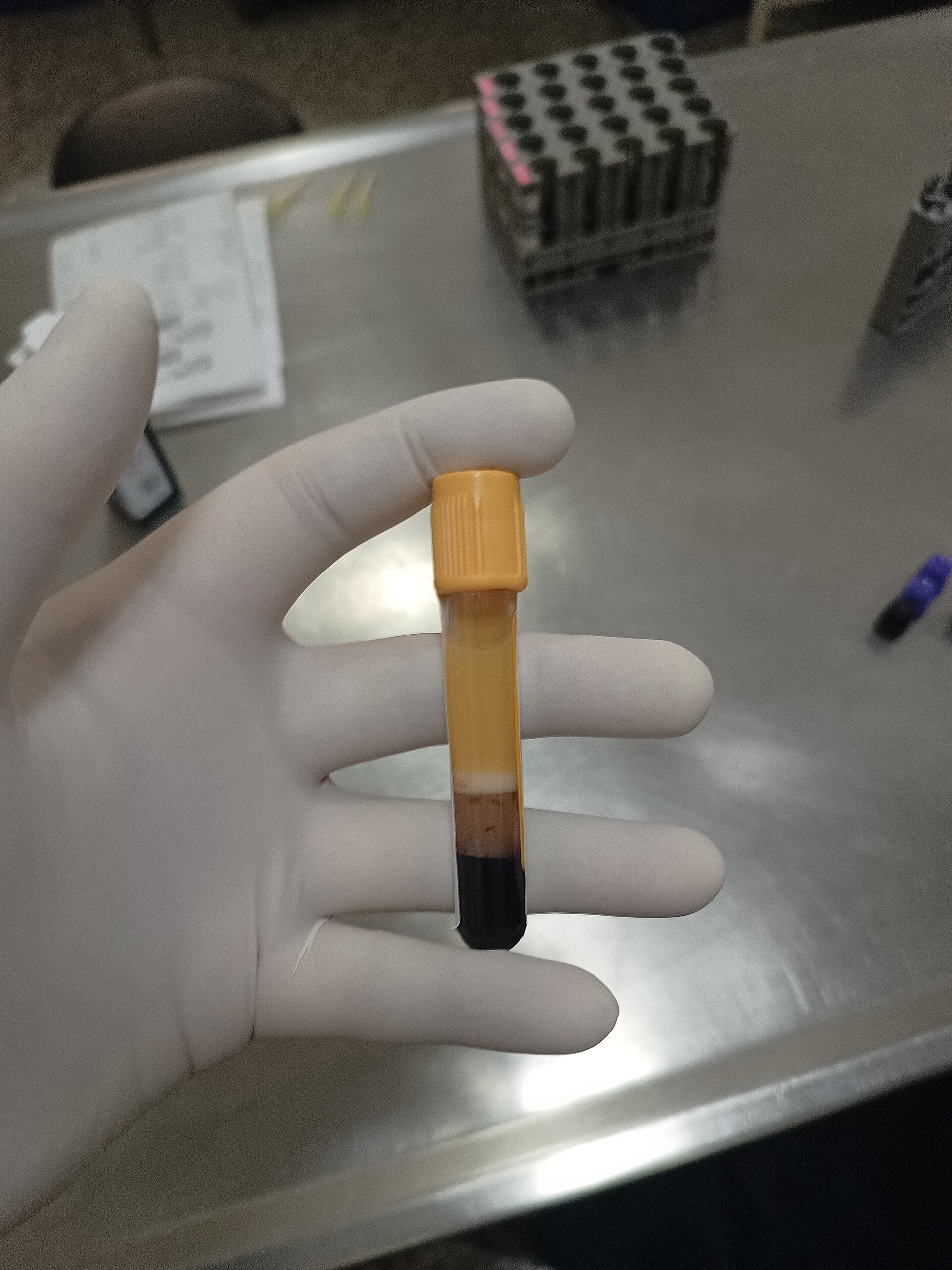
The centrifuged specimen shown arrives for a routine chemistry panel from a non-fasting outpatient. The panel is analysed successfully and all values fall within reportable limits. What should the technologist do about the appearance of the sample?
Partway through a batch, a technologist sees air bubbles passing through the reagent line of an analyser, primes the line, and the run continues normally with acceptable quality control. When should this be documented?
Getting the outcome to the right clinician in time
Releasing a result and communicating it are not the same act. You are expected to know which results can simply be posted to the chart, which must be telephoned, and how urgently — and then to reach a person who is licensed and able to act on the information, not merely someone who answers the phone. Read-back confirmation is standard practice for anything communicated verbally. When only part of a panel is ready and the clinician needs it now, you release what is verified as a clearly flagged preliminary report rather than holding everything or communicating informally.
A troponin on an emergency department patient exceeds the critical threshold. The technologist telephones the department and the ward clerk offers to write the value down and pass it along. What is the appropriate action?
An intensive care physician urgently needs a sodium on a hyponatraemic patient. The sodium has been verified, but the remaining analytes on the ordered panel will not be finished for another hour. What is the best course of action?
Closing the loop on every test that was ordered
A request is not finished when the specimen is analysed; it is finished when every ordered analyte has either a reported result or a documented reason why there is none. You are expected to work the pending or incomplete list before handover, chase orders that have quietly stalled — insufficient volume, a cancelled add-on, a specimen still sitting in a rack — and make sure each one is either resolved or handed over explicitly. Silent gaps are dangerous because the clinician usually assumes no result means normal, or does not notice the absence at all.
At the end of a night shift, the pending list shows an ordered magnesium on an inpatient with no result, no comment, and no record of the specimen being rejected. What should the technologist do?
Sending work onward for reflex and confirmatory testing
Some findings automatically trigger further work, and some of that work happens elsewhere. You are expected to recognise the triggers written into your laboratory's protocols — a screening immunoassay needing mass spectrometry confirmation, an abnormal electrophoresis pattern needing immunofixation — and to initiate that testing without waiting to be asked. Where the assay is performed at a reference centre, you prepare the aliquot to the receiving laboratory's specifications, label and package it correctly, supply the clinical information they need, and log the referral so the specimen can be traced. Responsibility for the final report normally stays with the referring laboratory.
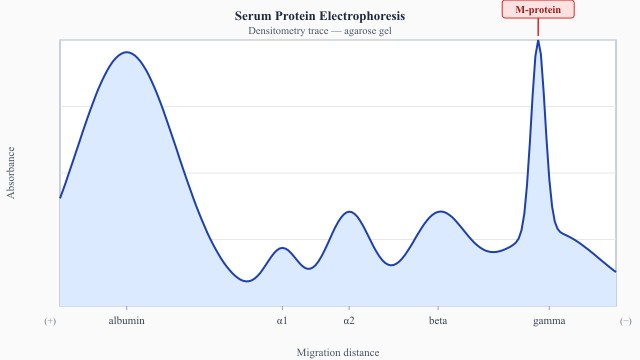
The densitometry scan shown was produced from a serum protein electrophoresis on a 68-year-old patient with back pain and anaemia. A discrete band is present in the gamma region. Under a standard laboratory protocol, what happens next?
A specialised hormone assay is not offered in-house and the serum aliquot must go to a provincial reference centre. What handling of the referral is correct?
Speaking up when quality or safety has failed
When something goes wrong — a released result from an out-of-control run, a mislabelled tube caught at the last moment, a chemical spill, an exposure incident — you are expected to raise it promptly through the laboratory's formal reporting channel rather than handling it privately. That means notifying the supervisor, filing the incident or near-miss report, and taking whatever immediate containment action is needed, such as recalling affected results. Near misses count: an error caught before it reached the patient still reveals a weakness in the process. Reporting systems are for learning and correction, not blame.
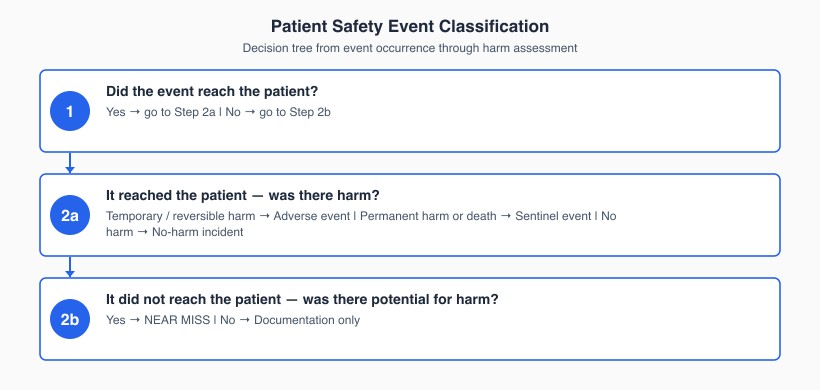
A technologist notices that two specimens were loaded into the wrong rack positions and catches the mix-up during verification, before any result leaves the laboratory. Using the classification pathway shown, how should this event be handled?
Reviewing the previous shift's work, a technologist finds that patient results were released from an analytical run in which the Level 2 control had failed and was never repeated. What is the appropriate response?
Routing specimens to where a diagnosis can be established
Some patients need an assay that no community laboratory performs — metabolic screens, rare enzyme assays, specialised endocrine or toxicology work — and the laboratory's job is to get the specimen to a centre that can make the diagnosis. That means knowing which centre accepts the test, meeting its requirements for specimen type, volume, additive, protection from light and temperature during transit, and supplying the clinical history and medication details the receiving laboratory needs to interpret the result. Packaging must satisfy transport of dangerous goods rules, and the dispatch is logged so the specimen remains traceable end to end.
An infant with unexplained metabolic acidosis and hypoglycaemia requires urine organic acid analysis, which is performed only at a tertiary metabolic centre. How should the specimen be sent?
Keep reading with a free account
The rest of this page — 6 more sections and 10 practice questions — is free to read with an MLTPrep account.
No card required.
Back to all clinical chemistry areas in the Clinical Chemistry study guide.
MLTPrep is an independent study resource. Not affiliated with or endorsed by CAMLPR. Always confirm current requirements with CAMLPR directly.