Transfusion Medicine
Quality Assurance
Quality assurance in transfusion medicine is the work that lets a compatibility report be trusted: proficiency challenges tested exactly like patient samples, daily reagent controls read and charted, component stock rotated before it outdates, and records that carry a patient's ABO and antibody history for life. This domain asks you to recognise when the data says a method has drifted, and to act on it before a unit leaves the issue fridge. Quality Assurance is one of the eight competency areas assessed in the Transfusion Medicine Fields-of-Practice examination set by CAMLPR.
Proficiency challenges tested like patient work
External quality assessment challenges arrive from a provider several times a year and must travel through the transfusion service exactly as patient samples do — the same staff, the same reagents, the same instruments and the same interpretation rules. Steering survey work to the most experienced technologist, or repeating it until the answers agree, hides how the centre actually performs. Results go back on the provider's form before the deadline, worksheets are kept, and when the report returns the centre's grading is compared with the consensus. Any graded discrepancy triggers a documented investigation — reagent lot, technique, transcription — with corrective action and follow-up.
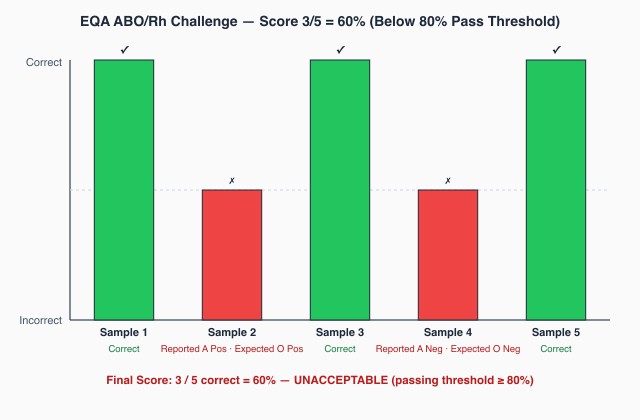
[IMAGE] summarises how a hospital transfusion service graded on the five samples of the most recent ABO and D survey. Three samples agreed with the consensus and two did not. Once this report reaches the laboratory, what best meets the service's obligation?
A survey box arrives holding three plasma samples for antibody identification. The charge technologist wonders how they should be worked up so the exercise tells the centre something useful about its own performance. Which approach does that?
Reading the daily control and calibration records
Every reagent that stands behind a patient result must be shown to work on the day it is used. In a transfusion service that means daily reactivity checks: anti-A, anti-B and anti-D against cells known to carry and to lack the antigen, reagent red cells checked against weak antisera, and anti-human globulin confirmed with IgG-sensitised cells. You look for the expected reaction strength, a genuinely negative negative, and no haemolysis or turbidity in the vial. Calibration counts too — serofuge spin time, cell washer volumes, incubator temperature and reader settings all have to be current before results leave the bench.
| Reagent | Reaction with antigen-positive cell | Reaction with antigen-negative cell |
|---|---|---|
| Anti-A | 4+ with A1 cells | 0 with B cells |
| Anti-B | 4+ with B cells | 0 with A1 cells |
| Anti-D | 4+ with R1R1 cells | 1+ with rr cells |
| Anti-IgG | 2+ with sensitised cells | 0 with unsensitised cells |
[TABLE] is the morning reagent check for a hospital blood bank, recorded before any patient typing was performed. Reading the anti-D line, what should the technologist do?
Spin time on a serologic centrifuge is verified by testing whether a programmed cycle gives a firm cell button and a clear supernatant. At the scheduled check, tubes removed after the programmed cycle show a loose button that falls apart before it can be graded. What does this finding call for?
Telling random scatter from a drifting method
Errors behave differently, so the response differs. Random error shows up as one-off outliers and widening scatter — a bubble trapped in a gel column, a thin cell suspension, a tube washed short — and it is usually settled by a careful repeat. Systematic error pushes results one way: a shift, where the control jumps to a new level and stays there after a lot change or a service call, and a trend, where grades creep run after run as antisera weaken or an incubator drifts. Charting control reactions every day is what makes either pattern visible before a patient is affected.
Show data table
| Run | Value (score) | SD from mean |
|---|---|---|
| D1 | 10.6 | +1.2 |
| D2 | 10.75 | +1.5 |
| D3 | 10.55 | +1.1 |
| D4 | 10.8 | +1.6 |
| D5 | 10.6 | +1.2 |
| D6 | 10.7 | +1.4 |
| D7 | 10.5 | +1.0 |
| D8 | 10.75 | +1.5 |
| D9 | 10.65 | +1.3 |
A transfusion service charts the reaction grade of its anti-A control cell each morning and reviews the plot weekly. [CHART] covers the last nine working days, with every point falling to one side of the mean. Which pattern is shown?
Review of the anti-B control shows the recorded reaction grade creeping steadily in one direction across fifteen runs, still inside the acceptable range. Nothing on the bench has been changed in that period. Which cause best explains this behaviour?
Sizing and rotating the component stock
A transfusion service holds perishable stock — red cells dated in weeks, platelets in days, thawed plasma in hours. You set minimum and maximum levels by group against local demand and the surgical list, issue the oldest compatible unit first so stock ages into use rather than into the bin, and watch outdate and wastage rates as indicators. Reagents and gel cards need the same discipline: inspect on receipt, store at the stated temperature, record lot and expiry, open the oldest lot first, and reject any vial showing haemolysis or turbidity. Group O D-negative red cells are the scarcest line and need active stewardship.
| Unit number | Group | Days to expiry | Status |
|---|---|---|---|
| R-4412 | A D-positive | 4 | Available |
| R-4478 | A D-positive | 19 | Available |
| R-4501 | O D-positive | 2 | Available |
| R-4530 | O D-negative | 6 | Reserved for emergency release |
[TABLE] lists the red cell units on the shelf. A group A D-positive patient is booked for a routine two-unit transfusion this afternoon and is not bleeding. Which unit should be selected first?
A small community hospital keeps four units of group O D-negative red cells on standby for emergency release. Two of them are now within a week of outdate, the operating schedule is light, and no crossmatch request is expected. Which practice best limits wastage of this scarce group?
Records that outlive the transfusion
Transfusion records are a safety system rather than paperwork. Before a group is reported, the current type is checked against the historical ABO and D result held in the laboratory system, and a mismatch stops the release until identity is resolved on a fresh sample. Antibody records are permanent: a specificity such as anti-Jka can fade below the detection limit yet still drive a delayed haemolytic transfusion reaction, so the history must be flagged where it cannot be overlooked. Traceability links every donor unit number to its recipient and to its fate — transfused, returned or discarded — and those records are retained for decades.
A 62-year-old man admitted overnight types as group O on the current sample. The laboratory system holds a group A result from an admission three years ago, and there is no record of a transplant or of a previous transfusion. What should happen before a group is reported?
A 44-year-old woman is booked for two units of red cells. Her antibody screen today is negative, but a record transferred last month from another hospital documents anti-Jka identified during a pregnancy in 2019. How should the units be selected?
Keep reading with a free account
The rest of this page — 4 more sections and 8 practice questions — is free to read with an MLTPrep account.
No card required.
Back to all transfusion medicine areas in the Transfusion Medicine study guide.
MLTPrep is an independent study resource. Not affiliated with or endorsed by CAMLPR. Always confirm current requirements with CAMLPR directly.