Histology
Reporting and Communication
Everything a histology technologist notices at the bench only counts if someone else can find it later. This domain covers the written record kept from specimen reception through to slide delivery, the reconciliation that proves no requisition, block or slide has gone missing, and the duty to speak up quickly when a quality or safety problem occurs. Weak documentation and slow escalation cause far more patient harm in anatomical pathology than technical error alone. Reporting and Communication is one of the eight competency areas assessed in the Histology Fields-of-Practice examination set by CAMLPR.
Writing down what you observe, from reception to slide release
Histology work passes through many hands, so the only reliable memory a case has is its written record. A technologist is expected to enter, at the time it happens, anything that changes the state or interpretability of the tissue: fragment counts that differ from the requisition, a specimen received dry or under-fixed, a shortened processing run, a block that faced poorly, chatter or folding on a section, a stain repeated. Entries belong in the case record or worksheet, dated and attributable, in plain language. A pathologist who can see why a section looks the way it does can tell processing effects apart from disease.
A 4 mm skin punch biopsy is received in a single container and is recorded at grossing as one intact core. At embedding the following morning, the technologist finds the tissue has separated into three pieces, all of which are embedded together in one block. How should the technologist handle this observation?
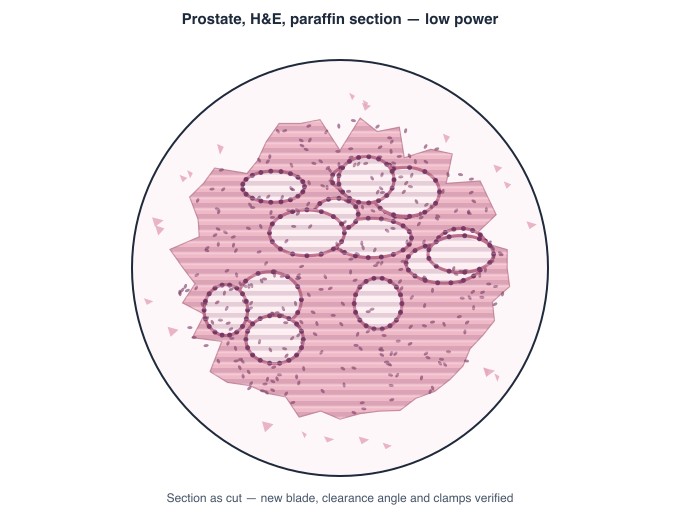
The prostate core section shown was processed overnight on a shortened schedule after a late add-on. The block was faced and recut twice, and the same appearance persisted each time. Which record entry best captures what the technologist has observed?
Reconciling every requisition, container, block and slide
Nothing may quietly disappear between the operating theatre and the pathologist's tray. The technologist reconciles at each handover: containers received against those listed on the requisition, blocks embedded against the grossing description, slides cut and stained against blocks, and slides delivered against the day's outstanding work. Any shortfall is chased at the time and logged as pending rather than closed out. The same discipline applies to special stains, immunohistochemistry, recuts and cases sent for outside consultation, since an unreturned block is as serious as a lost specimen.
During end-of-shift reconciliation, a technologist finds that a colon resection case was accessioned with six blocks, but only five stained slides are on the delivery tray. The sixth block is not at the microtomy station, the stainer or the coverslipper. What is the appropriate next step?
A requisition for a transurethral resection lists two separately labelled containers, A and B, from the same procedure. Only container A reaches the specimen reception area, and no second container is found in the transport cooler. What should the technologist do before any tissue is grossed?
Escalating quality failures and safety incidents without delay
When something goes wrong the technologist reports it, promptly and through the defined channel, even when the problem has already been contained or was caused by the technologist. That covers chemical spills, sharps injuries, exposure to fixative vapour and equipment faults on the safety side, and control failures, mislabelled blocks, cross-contamination and released results later found to be wrong on the quality side. Fixing a problem silently is not acceptable: the report is what triggers assessment of other cases in the same run, corrective action, and any patient notification the pathologist decides is needed.
While decanting neutral buffered formalin at the grossing bench, a technologist spills roughly 400 mL onto the floor outside the fume hood. The spill kit is used correctly, the area is ventilated, and no one required first aid. What must happen next?
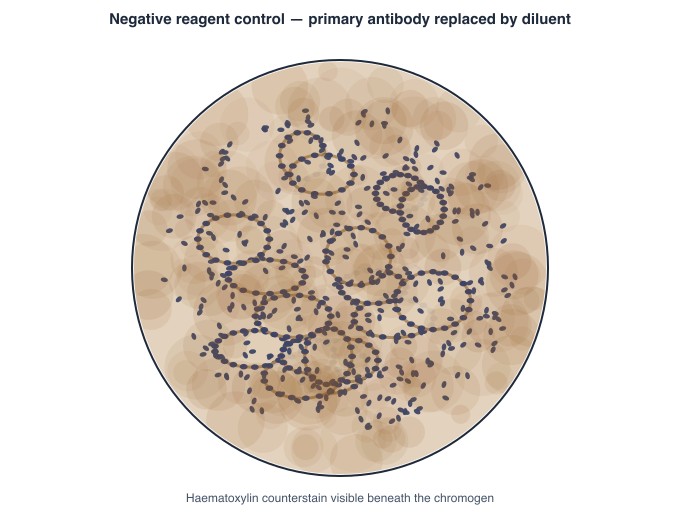
The negative reagent control accompanying a CD20 immunohistochemistry run shows the diffuse brown chromogen seen in the image, and the patient sections from the same run carry comparable background. The slides have already been coverslipped and are ready for delivery. What should the technologist do?
Keep reading with a free account
The rest of this page — 2 more sections and 4 practice questions — is free to read with an MLTPrep account.
No card required.
Back to all histology areas in the Histology study guide.
MLTPrep is an independent study resource. Not affiliated with or endorsed by CAMLPR. Always confirm current requirements with CAMLPR directly.