Hematology
Specimen Collection
Specimen collection is where most results are won or lost: an assay run flawlessly on the wrong tube, the wrong patient or a clotted sample is still a wrong result. This domain covers everything that happens before testing begins — instructing collectors, questioning the order, confirming identity, drawing the blood, judging the specimen's condition, recording it, and getting it to the bench in time. Roughly fifteen percent of the field's questions sit in this area, and they reward practical judgement far more than recall. Specimen Collection is one of the eight competency areas assessed in the Hematology Fields-of-Practice examination set by CAMLPR.
Telling patients and staff what the laboratory needs
Much of a blood specimen's quality is decided before it ever reaches the bench, so technologists are expected to give clear, practical direction to whoever collects it. That means naming the right tube and additive, the volume required, how many inversions, and any timing or temperature condition — a cold agglutinin specimen kept warm, a platelet function sample hand-carried. It also means answering patient questions plainly: what the draw involves, whether medication or fasting matters, how long results take, and what happens if a second attempt is needed. Vague instruction produces recollections, delayed care and avoidable patient discomfort.
A nurse on a surgical unit telephones the laboratory. She has one 2.7 mL sodium citrate tube left, it drew only about half full, and a prothrombin time is needed for a morning review. What should the technologist advise her to do?
A family practice rings ahead of sending a patient for cold agglutinin titre testing and asks how the blood should be looked after between the draw and the courier run. What instruction should the technologist give?
Questioning orders that cannot give a useful answer
Not every order that arrives can produce a meaningful result. A technologist reviews requests against the patient's age, working diagnosis, recent results and the stated limits of the assay, then raises the concern before blood is drawn rather than after it is tested. Typical examples include a solubility screen ordered on an infant whose foetal haemoglobin still predominates, a repeat count requested hours after an unchanged result, or an assay invalidated by current anticoagulant therapy. The technologist does not cancel an order unilaterally — the query goes back to the requesting clinician with the technical reason stated plainly, and the outcome is documented.
A requisition arrives asking for a sickle solubility screen on a six-week-old infant whose grandmother has sickle cell disease. Why should the technologist telephone the ordering clinician before proceeding?
Checking the tube against the paperwork
Every specimen is matched to its paperwork before anything is tested. The names, birth date and health identifier on the tube must agree exactly with those on the requisition, and so must the collection date and time, the collector's identification, the tube type and the tests ordered. A single digit out of place is treated as a mismatch rather than a clerical slip, because it may mean two patients' samples were exchanged. Where the discrepancy cannot be resolved with certainty by the person who actually drew the blood, the specimen is rejected, a fresh one requested, and the event logged.
A courier delivers an EDTA tube for a complete blood count. The tube label reads Okonkwo, Adaeze — 1966-04-12, while the requisition in the same bag reads Okonkwo, Adaeze — 1996-04-12. What is the appropriate action?
Judging whether a sample is fit to test
A tube can be perfectly labelled and still be unfit to test. Technologists inspect for clots, short draws, haemolysis, gross lipaemia, the wrong additive, exposure to heat or cold, and excessive transport delay, then decide whether the sample can be salvaged, released with a qualifying comment, or rejected outright. Some faults are correctable: a specimen showing cold agglutination is warmed and re-run, and a clumped platelet count is confirmed on citrate. Others are not — a clotted count tube always goes back to the ward. The decision and the reason for it belong in the permanent record.
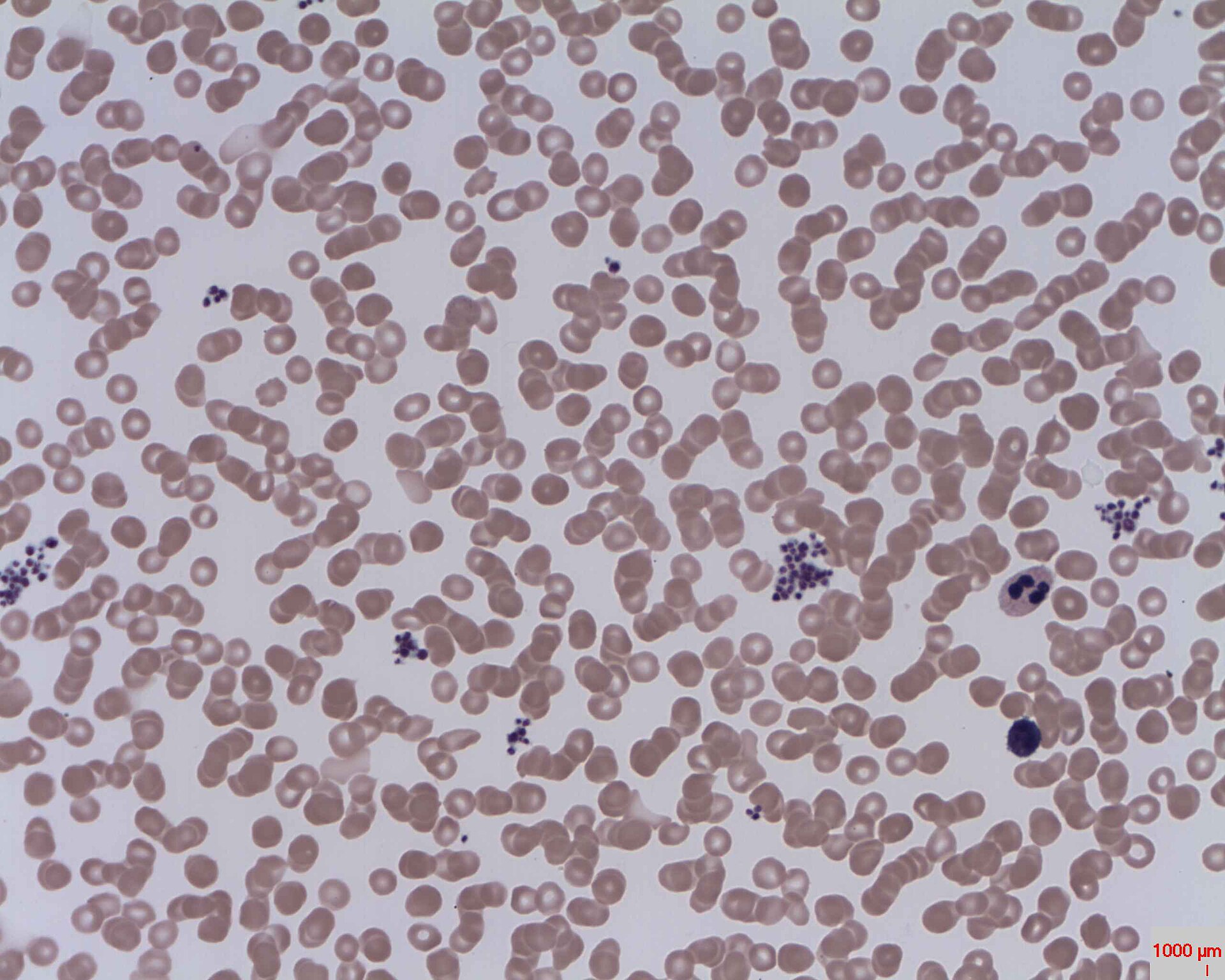
An analyser reports a platelet count of 22 × 10⁹/L on a woman booked for elective knee surgery who has no bruising or bleeding history. A film made from the same EDTA tube is shown. What does this tell the technologist about the specimen?
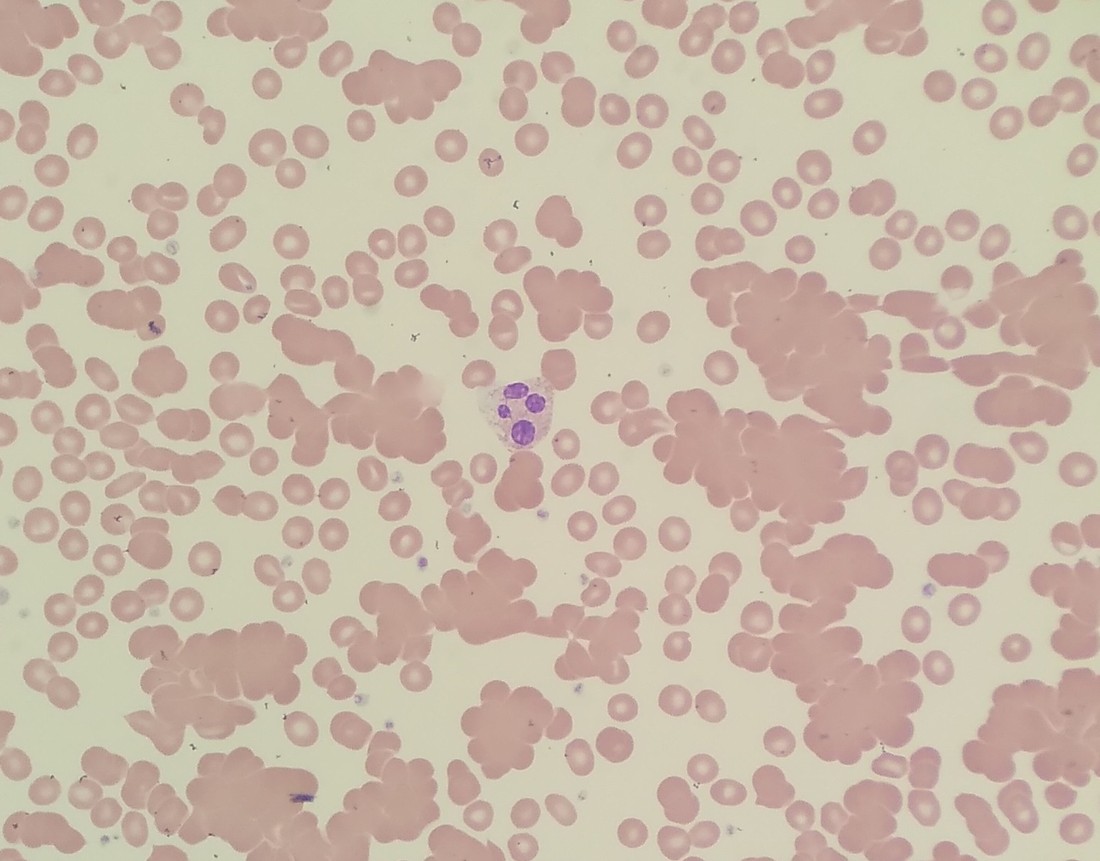
An EDTA specimen travels across town by courier during a January cold snap. The analyser returns an RBC of 2.1 × 10¹²/L with an MCHC of 421 g/L, and the stained film prepared from the tube is shown. What should the technologist do with this specimen?
Handling specimens that may end up in court
A small proportion of specimens may later be produced as evidence, and these are handled to a stricter standard than routine work. The technologist confirms identity against photographic identification, seals the container with tamper-evident tape, and records every change of possession — who released it, who received it, and at what time — on an unbroken custody document. Nothing is left unattended and nothing changes hands verbally. Beyond custody work, the same legal framework governs informed consent, a patient's right to refuse, the limits on collecting from minors or incapable adults, and how long records and residual samples must be kept.
Blood is drawn from an employee for testing that may later be produced at a workplace tribunal. The sealed specimen is about to be handed to a courier at the laboratory counter. Which step is essential at that moment?
Capturing the specimen's details in the LIS
Accessioning is the moment a physical tube becomes a traceable record. The technologist enters or verifies the patient identifiers, the ordering clinician, the tests requested, the tube type, the collection time as documented by the collector, and the time the laboratory took receipt — these are two separate fields, and both matter when a delay has to be explained later. Priority status, specimen condition comments and any rejection reason are captured at the same point. Guessed free text and back-dated entries corrupt turnaround statistics and destroy the very audit trail the record exists to provide.
A ward sends an EDTA tube annotated by the collector with a draw time of 06:15. The specimen is accessioned in the laboratory at 08:40. Which entry should the technologist make in the laboratory information system?
Deciding what travels to the laboratory first
Specimens do not all tolerate the same journey. The technologist ranks what leaves first by clinical urgency and by how quickly each analyte deteriorates: coagulation samples from anticoagulated patients carry the tightest windows, films for parasite screening should be made promptly, and routine counts tolerate a much longer wait. Transport conditions matter as much as speed — samples for platelet function work are hand-carried because pneumatic systems activate platelets, and cold agglutinin specimens must travel warm. Knowing the published stability limit for each test is what turns an ordinary delivery list into a defensible priority order.
Four tubes are sitting in the collection tray at a rural clinic and one courier run is leaving in the next few minutes. Which of them has the tightest delivery deadline?
A ward clerk asks whether a citrated specimen for platelet function analysis may be dropped into the pneumatic tube system to save a trip. How should the technologist answer?
Deciding what gets worked up first at the bench
Once specimens are inside the department, the same reasoning is applied to bench order. Urgent coagulation work on a bleeding patient precedes a routine outpatient count; a sedimentation rate has a fixed setting-up window; films are made from EDTA blood well inside the interval that preserves morphology. The technologist weighs clinical urgency, additive stability and the practical sequence of the instrument run, and re-orders the queue when a new urgent request lands rather than working strictly first-in, first-out. Documenting why a sample was held back protects the laboratory when turnaround times are later audited.
A technologist returns to the bench and finds four specimens received during the past few minutes. Which one should be prepared first?
Spotting the mismatch before it becomes a result
Discrepancy detection is the habit of noticing when two pieces of information cannot both be true. A haemoglobin that has nearly doubled in four hours without transfusion, a documented collection time later than the receipt time, a tube additive that does not suit the test ordered, a second unlabelled tube inside a bag holding one requisition — each of these signals an error in collection or documentation rather than a genuine change in the patient. The technologist stops, investigates, and involves the collector or the ward before anything is reported. Reporting first and querying afterwards is how wrong-patient results reach charts.
A transport bag arrives holding two EDTA tubes and one requisition. One tube carries a complete label; the other carries a given name only. What should be done with the partly labelled tube?
A repeat count on a clinically stable dialysis patient returns a haemoglobin of 148 g/L. The value from four hours earlier was 82 g/L and no blood components were given in between. What is the most likely explanation?
Proving the patient is who the label says
Identification is the one step with no safety net further downstream. Two independent identifiers are confirmed at the bedside or the drawing chair and matched against the requisition — usually the full name and date of birth, or a unique health number. A conscious patient is asked to supply those details openly rather than invited to agree with something read aloud. For a sedated, confused or very young patient the wristband is the source and is checked against the paperwork; bed cards, door numbers and a relative's word are not acceptable substitutes. Without reliable identification the draw waits.
A technologist arrives at the bedside of a heavily sedated inpatient who cannot respond to questions. An intact armband is in place on the left wrist. How should identity be established before the draw?
At an outpatient drawing station a man hands over a requisition for coagulation studies and sits down. Which combination satisfies a two-identifier check?
Drawing the sample itself
The draw carries most of the pre-analytical risk. The technologist selects an appropriate site and device, keeps tourniquet time to about a minute to avoid haemoconcentration, follows the additive sequence that prevents carry-over between tubes, fills each tube to its stated volume, and mixes by gentle inversion rather than shaking. Line draws need an adequate discard so residual flush does not dilute the sample. Capillary and neonatal collections have their own depth, site and volume limits. Complications — a forming haematoma, a fainting patient, unexpectedly pulsatile flow — are managed at the chair before anyone thinks about the specimen.
During a difficult collection the technologist has kept the tourniquet applied for a little over two minutes while palpating for a suitable vein. A workable vein is now located. What should be done before the tubes are filled?
Peripheral access has failed twice, and coagulation studies must now be obtained from the patient's existing central venous catheter. What must the technologist do first?
Back to all hematology areas in the Hematology study guide.
MLTPrep is an independent study resource. Not affiliated with or endorsed by CAMLPR. Always confirm current requirements with CAMLPR directly.