Hematology
Reporting and Communication
This domain covers everything that happens to a haematology result after the analyser stops counting: how it is documented, how it is released, who is told and how quickly, and what is written down when something goes wrong. It also covers the specimens and films that must leave your hands — sent to a reference centre, or put in front of a pathologist while the finding still matters. A technically perfect count that is badly reported, quietly lost, or never escalated does the patient no good at all. Reporting and Communication is one of the eight competency areas assessed in the Hematology Fields-of-Practice examination set by CAMLPR.
The written trail behind every released result
Every number a haematology bench releases carries a paper or electronic trail behind it. This area covers what you write down when you verify a count, when you telephone a critical platelet or haemoglobin value to a ward, and when a figure already released has to be amended. Expect to record who you spoke to, the time of the call, and the read-back they gave you. Amendments never erase history: the original entry stays visible, flagged, with the reason attached. Clinicians and auditors both rely on that trail months later.
At 03:40 a haematology technologist reaches a ward nurse to pass on a platelet count of 8 x 10⁹/L on an inpatient. Beyond the value itself, which set of details belongs in the laboratory record of that call?
A haemoglobin of 71 g/L released two hours ago is traced to a specimen drawn from an arm carrying a running saline infusion. A properly collected repeat gives 104 g/L. How should the earlier entry be handled in the laboratory information system?
Recording what you saw, not only what you measured
Analysers report numbers; technologists notice things. A tube that arrived warm, fibrin strands in an EDTA specimen, platelets rimming neutrophils on a film, a sample that clotted in transit — these observations change how a clinician reads the result, and they belong in the record rather than in your head. This area asks you to capture pre-analytical, analytical and post-analytical observations in the laboratory information system where the next person will find them. A bench notepad, a sticky note, or a verbal handover is not documentation.
While pulling a wedge film from an EDTA tube on the evening run, a technologist notices fine fibrin strands trailing from the spreader. The analyser count on that tube fell within the patient's usual range. What is the appropriate handling of that observation?
An automated platelet count of 78 x 10⁹/L triggers a film review. The film prepared from the EDTA tube shows platelets rosetting around neutrophils, and a citrated recollection counts 210 x 10⁹/L. What should the technologist document alongside the corrected count?
Releasing outcomes a clinician can act on
Reporting is more than transcribing a value. A leucocyte count needs correcting when nucleated red cells are present, a paediatric haemoglobin needs an age-matched interval beside it, and a diluted specimen needs its factor applied before release. This area covers units, reference intervals, corrections, interpretive comments, and the difference between a preliminary and a final report. The working test is whether a clinician reading your report can act on it without telephoning to ask what you meant. Ambiguity at this step is a patient safety problem, not a clerical one.
A film from a two-year-old with a known haemoglobinopathy shows 25 nucleated red cells per 100 leucocytes. The analyser reported a leucocyte count of 15.0 x 10⁹/L. What leucocyte figure should be released?
A haemoglobin of 108 g/L is generated on a six-month-old infant seen in a paediatric outpatient clinic. Against which interval should the laboratory report present that value?
Making sure nothing ordered is quietly lost
Requests go missing in ordinary ways: a tube rolls behind a rack, an order is received but never accessioned, an analyser aborts a run overnight and nobody notices. This area is about the reconciliation habit — comparing what was ordered against what has been resulted, working the pending list before handover, and chasing anything unresolved instead of leaving it for someone else. Where a specimen genuinely cannot be found or tested, that outcome is documented and the requester is told, so a clinician is never left waiting on a result that will never arrive.
Ten minutes before handover the pending list still carries a reticulocyte count ordered at noon. There is no result, and no matching tube can be found at the bench or in the fridge. What should the technologist do before leaving?
Passing a specimen on to the right person
Not every specimen finishes its journey at your bench. Haemoglobinopathy studies, specialised factor assays and flow cytometry often travel to a reference centre, while other samples need a charge technologist or designated senior to look before anything is released. This area covers knowing where a specimen has to go, packaging and transporting it under the right conditions, and sending the information that travels with it — collection date and time, patient identifiers, clinical details and treatment history. A referral without that context arrives at the receiving laboratory effectively unusable.
A bleeding disorders clinic orders a specific factor assay that the site does not perform, so the separated citrated plasma must travel frozen to a reference centre in another province. Which information must accompany the referred specimen?
Speaking up when quality or safety slips
Breaches happen: controls outside limits accepted and patient results released anyway, a cracked centrifuge cup, a spill, a specimen tested under the wrong identifier, a fridge that drifted overnight. This area is about escalating rather than absorbing. The expectation is a prompt verbal alert to the supervisor plus a written occurrence or incident report, followed by whatever containment the event needs — recalling released results, quarantining a reagent lot, decontaminating a work centre. Non-punitive reporting systems only reduce harm if technologists actually file the report at the time.
Show data table
| Run | Value (seconds) | SD from mean |
|---|---|---|
| 1 | 12.5 | +0.0 |
| 2 | 12.6 | +0.2 |
| 3 | 13.4 | +2.3 |
| 4 | 13.5 | +2.5 |
| 5 | 13.6 | +2.7 |
| 6 | 13.4 | +2.3 |
| 7 | 12.5 | +0.0 |
| 8 | 12.6 | +0.2 |
The incoming technologist reviews the prothrombin time control chart from the shift just finished. The runs were accepted at the time and roughly 40 patient reports went out. Looking at the pattern shown, what is the appropriate first step?
After a spin, a sealed centrifuge cup is found cracked with dried blood inside the bowl. The technologist decontaminates the rotor and takes the centrifuge out of service. What else does this event require?
Escalating a film that suggests a new diagnosis
Some findings cannot wait for the routine round. Blasts with Auer rods in a previously untested adult, malarial parasites on a thin film, marked red cell fragmentation with thrombocytopenia, or a striking lymphocytosis all need a pathologist or designated haematologist to see the material while it still matters clinically. This area covers recognising those triggers, telephoning the finding to the right person, and physically routing the slide or specimen onward with your own observations attached. Your job is to raise and refer the finding promptly, not to issue the diagnosis yourself.
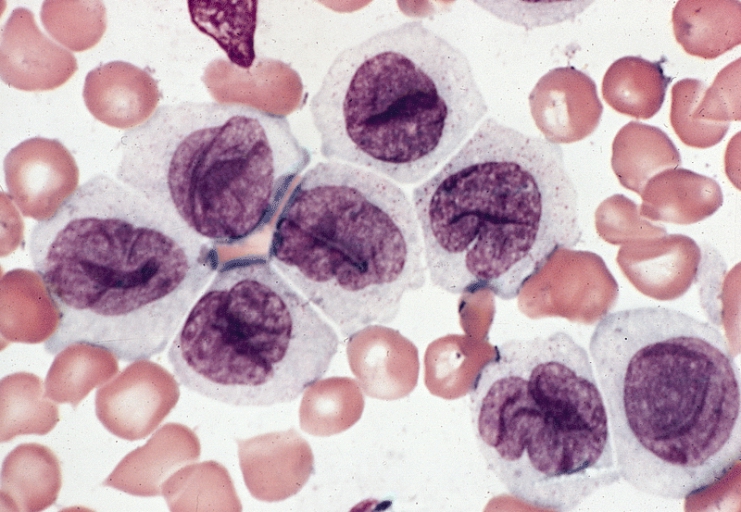
An outpatient's first ever complete blood count returns a leucocyte count of 42 x 10⁹/L with a haemoglobin of 88 g/L. The film shows the immature mononuclear population illustrated. What should the technologist do with the film?
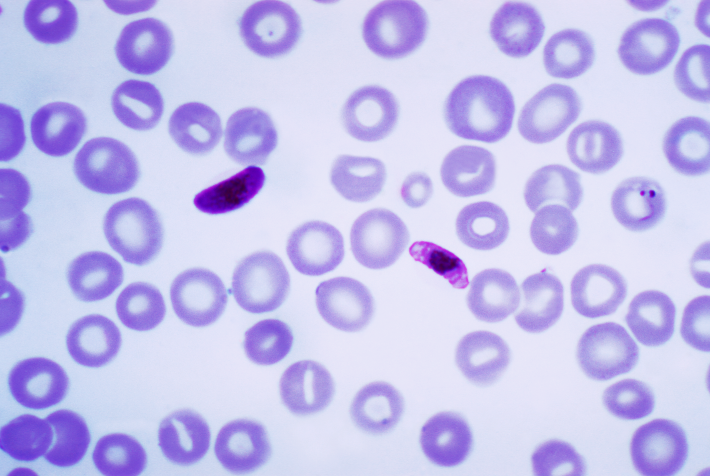
A woman who returned from Lagos five days earlier attends a walk-in centre with fever and rigors. Thin films are prepared and the technologist observes the appearance shown. Which action best meets the technologist's reporting obligation?
Keep reading with a free account
The rest of this page — 6 more sections and 10 practice questions — is free to read with an MLTPrep account.
No card required.
Back to all hematology areas in the Hematology study guide.
MLTPrep is an independent study resource. Not affiliated with or endorsed by CAMLPR. Always confirm current requirements with CAMLPR directly.