Clinical Microbiology
Specimen Collection
Microbiology results are won or lost before the specimen ever reaches a plate: an organism that was never sampled, or that died on the way in, cannot be recovered by any downstream skill. This domain covers instructing collectors, screening out requests that will not answer the clinical question, confirming identity and paperwork, judging whether what arrived is still fit to test, and deciding what moves and what is set up first. Its failures are invisible at the bench and expensive on the report. Specimen Collection is one of the eight competency areas assessed in the Clinical Microbiology Fields-of-Practice examination set by CAMLPR.
Telling patients and collectors how to obtain a usable specimen
Most microbiology failures begin before the specimen reaches the bench, so technologists are expected to give patients and collectors specific, usable direction. That means naming the correct container and preservative, the anatomical site, the volume the method actually needs, and the window within which the specimen must arrive. It also means explaining why an instruction exists — that a first-morning deep-cough sputum outperforms saliva pooled across a day, or that swabbing dry slough says nothing about the infected tissue beneath it. One clear set of instructions prevents a repeat collection, a delayed diagnosis and a second visit for the patient.
A community clinic nurse telephones the laboratory before sending a patient home with a container for mycobacterial culture of sputum. Which instruction will most improve the chance that an adequate specimen is produced?
A wound care nurse asks the laboratory how to sample a chronic leg ulcer whose surface is covered by a layer of dry slough. What should the technologist advise?
Spotting requests the laboratory cannot usefully answer
Not every request that arrives is a question the laboratory can answer. Technologists are expected to recognise orders that will generate a result without clinical meaning: anaerobic culture on a voided urine, a routine enteric stool culture on diarrhoea that began well into a hospital stay, daily repeat cultures on a stable patient, or a specimen sent looking for an organism the requested method cannot recover. The response is not a silent refusal. It is a call to the requester that explains the limitation and offers the test that answers the real clinical question, with the conversation recorded against the specimen.
On her sixth day in hospital a patient develops watery diarrhoea, and the ward submits a request for routine enteric stool culture. How should the technologist respond to that order?
A voided midstream urine arrives with a handwritten addition to the requisition asking for anaerobic culture. How should the technologist handle that part of the request?
Checking that the container and the paperwork agree
Before anything is accessioned, the container and the requisition have to tell the same story. The technologist confirms that names, unique identifiers, collection date and time, anatomical site and the number of containers match on both, and that the label sits on the container rather than on the bag around it. In microbiology a site mismatch is not clerical trivia: the stated source decides which media are inoculated, which atmosphere the plates go into, and how any normal flora recovered will be interpreted. Where the two disagree, the collector resolves it, not the laboratory.
A syringe of joint fluid is labelled left knee while the requisition accompanying it records the site as right knee. All other details on the two match. What should happen next?
Judging whether what arrived can still give a valid result
Integrity assessment asks whether the material in front of you can still support a defensible result. The technologist checks volume against what the method needs, container and preservative type, transport temperature and elapsed time, leakage, gross contamination, and for respiratory specimens the cytological screen for squamous contamination. Some faults are fatal: a swab that has dried out, or a culture specimen frozen in transit. Others degrade the result without destroying it — a sterile fluid left overnight in a ward refrigerator is still processed when fastidious organisms are suspected, because a positive result remains informative, but the delay is reported alongside it. Others are recorded as limitations and reported beside the result so the clinician can weigh how much confidence it deserves.
A wound swab reaches the laboratory in a tube containing no transport medium. The tip is visibly dry and the recorded collection time was eleven hours earlier. What is the appropriate handling?
A cerebrospinal fluid sample requested for bacterial culture spent the night in a ward refrigerator and arrives the following morning. What is the main concern about its integrity?
Specimens that are also legal evidence
Some specimens are evidence as well as clinical material. Forensic collections, workplace substance testing and specimens tied to a coroner's investigation travel under chain of custody: every transfer signed and timed, seals intact, containers uniquely identified, and storage documented from collection through to disposal. The technologist verifies the seal and the paperwork on arrival, signs for the transfer, restricts access to the specimen, and records any irregularity rather than quietly putting it right. A broken seal is reported to the submitting authority and documented; it is never resealed, because a repaired seal destroys the very assurance the seal was there to give.
Swabs collected during a police investigation arrive with a signed transfer form and a numbered seal, and the technologist notices that the seal has been broken. What is required?
Turning a specimen into a traceable record in the LIS
Accessioning is where a specimen becomes a record that can be traced. The technologist enters patient identifiers, ordering clinician, collection date and time, receipt time, anatomical source, tests requested and any special instruction, then applies the accession label. Source coding matters more in microbiology than in most disciplines, because the entered site drives media selection, incubation atmosphere, work-up rules, reporting comments and turnaround targets. A vague entry such as wound, other quietly weakens all of them. Rejections, limitations and conversations with the ward belong in the same record, not in a note on the bench.
A swab is accessioned with its source entered as wound, other because the requisition names no anatomical site. Why does that generic entry matter further along the workflow?
Deciding which specimens travel first
Delivery priority is a judgement about what deteriorates fastest and what changes management soonest. Cerebrospinal fluid, sterile body fluids, tissue from theatre and specimens sought for fastidious organisms such as Neisseria gonorrhoeae move immediately, at the temperature that keeps the organism alive. Preserved material — urine in boric acid, stool in fixative, screening swabs in transport medium — tolerates the scheduled courier run. Technologists are expected to know which specimens must never be chilled, which must be, and when the right answer is to call for a dedicated run rather than wait for the next one.
Four microbiology specimens are waiting at a rural collection site for a courier that runs twice daily. Which one should be escalated ahead of the scheduled run?
A cervical swab for gonococcal culture is taken at an evening clinic located forty minutes from the laboratory. Which transport arrangement best protects the yield?
Deciding the order of work once specimens reach the bench
The same reasoning that ranks transport ranks the bench queue. Irreplaceable sterile-site material is set up first — joint and pleural aspirates, tissue from theatre, cerebrospinal fluid — followed by specimens whose yield falls with every hour of delay, with preserved urines and screening swabs last. There is an order within a single specimen too: anaerobic media are inoculated before aerobic ones from a closed aspirate, and with a scarce volume the media are inoculated before smears, since a culture can be repeated from a plate but never from a slide. Prioritising also means protecting sterile specimens from cross-contamination during a crowded setup.
Several specimens land on the bench together at shift changeover and cannot all be set up at once. Which should be processed first?
A syringe of pus aspirated from a deep abscess is submitted for aerobic and anaerobic culture. How should the technologist sequence the setup?
Noticing when a specimen or its paperwork does not add up
Discrepancy detection is the habit of noticing that something about a specimen does not fit. Two blood culture bottles arriving when the requisition records four. A collection time later than the receipt time. A urine labelled midstream that shows heavy mixed growth. A second container with no label at all. The technologist traces the problem back to the collector rather than reconstructing the missing detail from a chart, records both the finding and how it was resolved, and escalates a repeating pattern from one collection area into the quality system so the cause is fixed rather than absorbed.
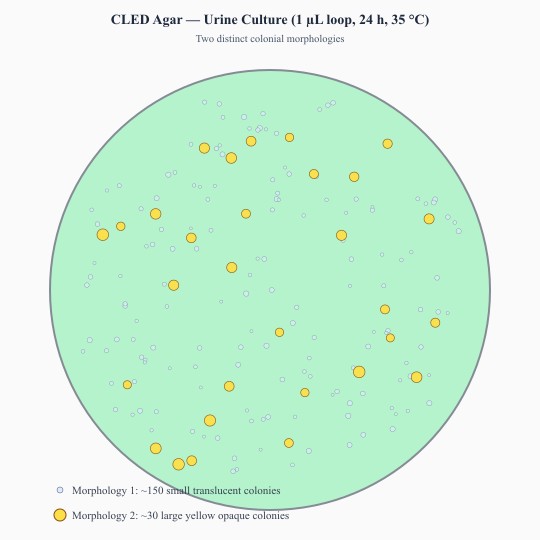
The plate shown was inoculated from a voided urine submitted by a family practice, and two clearly different colony types have grown in substantial numbers. What does this growth pattern most likely say about how the specimen was obtained?
One aerobic blood culture bottle arrives on its own. The requisition records two sets drawn from separate sites, and the bottle carries no draw site and no draw time. What is the technologist's first step?
Confirming that the specimen belongs to the patient named on it
Identification is the one check with no acceptable failure rate. At collection the patient is identified actively using two independent identifiers verified against the requisition and the wristband, and the container is labelled at the bedside before the collector steps away. The same two identifiers are matched again at accessioning. Patients who cannot confirm their own details — infants, unconscious trauma arrivals, people with dementia or without a shared language — are identified through the wristband, a temporary unique identifier or an accompanying caregiver. Unlabelled specimens are never labelled retrospectively by laboratory staff, however inconvenient a recollection may be.
An adult brought in after a highway collision cannot be named and is registered under a temporary hospital identifier. Blood cultures are drawn in the resuscitation bay. What must appear on the bottles for the laboratory to accept them?
Back to all clinical microbiology areas in the Clinical Microbiology study guide.
MLTPrep is an independent study resource. Not affiliated with or endorsed by CAMLPR. Always confirm current requirements with CAMLPR directly.