Clinical Microbiology
Safety
Microbiology is the one discipline where the specimen itself is the hazard, so safe practice is built into every step rather than added at the end. This domain covers barrier protection, hand hygiene, the packaging and transport of infectious material, the recognition of organisms that demand higher containment, and the duty to raise a hazard the moment it is noticed. Expect scenario questions that ask what you would do at the bench, not definitions. Safety is one of the eight competency areas assessed in the Clinical Microbiology Fields-of-Practice examination set by CAMLPR.
Choosing and wearing barrier protection at the bench
Barrier protection in microbiology is matched to the task, not worn out of habit. A fluid-resistant laboratory coat, gloves and eye protection form the routine baseline for handling cultures and open specimens; a fitted respirator is added only when an aerosol-transmissible organism is suspected or when work moves to higher containment. A technologist is expected to select the right combination before starting, keep gloved hands away from telephones, keyboards and door handles, and remove items in an order that avoids self-contamination. Coats stay in the laboratory. Damaged or visibly soiled gloves are changed immediately, not wiped clean.
A technologist is subculturing a routine positive blood culture broth and preparing a smear from it inside a certified Class II biological safety cabinet. Nothing in the history suggests an aerosol-transmissible organism. Which combination of protective equipment is appropriate for this task?
A technologist finishes plating specimens and is called to a meeting outside the laboratory. The gloves are visibly wetted with culture broth. Which action should be taken first?
Hand hygiene and personal cleanliness in the laboratory
Hand hygiene is the single most effective control against laboratory-acquired infection, and the method matters as much as the moment. Alcohol-based rub is adequate for most transitions between clean tasks, but it does not kill bacterial spores, so soap and running water are required after handling stool, anaerobic cultures or anything suspected of containing Clostridioides difficile. Technologists wash on entering and leaving the bench area, after glove removal, before eating and after any splash. Related habits belong here too: no food, drink or cosmetics at the bench, hair tied back, and cuts covered before gloving.
A technologist has just finished plating a series of stool specimens, several of which were submitted for Clostridioides difficile investigation, and removes the gloves before moving to the reporting desk. Alcohol-based hand rub and a sink are both within reach. What is the correct hand hygiene step?
Packaging and shipping infectious specimens
Any specimen leaving the building becomes a regulated shipment under the Transportation of Dangerous Goods rules, and the technologist who packs it carries responsibility for getting it right. Most diagnostic specimens ship as Biological Substance, Category B under UN 3373; the far more restrictive Category A, UN 2814 classification turns on what the material can cause rather than on whether it is a culture — cultures meet the threshold most readily, but a patient specimen can be Category A in its own right. Every shipment uses triple packaging: a leak-proof primary container, a leak-proof secondary container, and a rigid outer package with the correct marking, with absorbent material between the first two in a quantity sufficient to take up the whole volume. Certification training must be current, and refrigerant such as dry ice is declared separately.
A rural collection site sends a stool specimen by road courier to a regional laboratory for routine enteric culture. There is no indication that it contains an agent capable of causing life-threatening or permanently disabling disease. Which classification and marking apply to this shipment?
A cerebrospinal fluid specimen is being prepared for courier transport to a reference centre for molecular testing. Which packing arrangement satisfies the triple packaging requirement?
Working safely with high-containment and select agents
Diagnostic laboratories work at containment level 2, but certain findings mean the work must stop and move up. Suspicion of Mycobacterium tuberculosis, Brucella, Francisella tularensis, Burkholderia pseudomallei, Coccidioides or Bacillus anthracis calls for containment level 3 practices, or referral to a laboratory that has them. The sentinel laboratory role is to recognize the possibility early, avoid procedures that generate aerosols, seal and secure the culture, and contact the provincial public health laboratory rather than attempt identification. Clues are often mundane: a non-motile, non-haemolytic spore-forming rod, or a tiny fastidious growth from blood after several days.
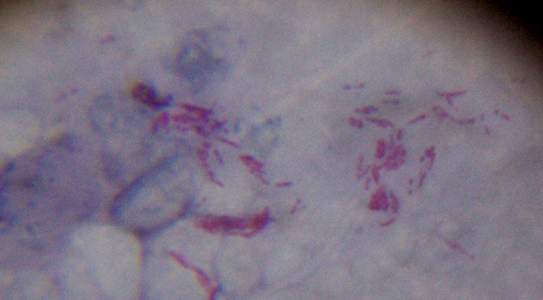
A concentrated sputum smear from a newly admitted patient with a chronic cough is examined after Ziehl-Neelsen staining, and the appearance shown is what oil immersion reveals. Under what arrangement should subsequent manipulation of the corresponding culture be carried out?
An aerobic blood culture from a patient with a rapidly worsening illness grows large, flat, non-haemolytic grey colonies on sheep blood agar. The Gram stain shows broad Gram-positive rods with unstained oval spores, and the isolate is catalase positive. What should the technologist do next?
Spotting hazards and raising them promptly
Safety systems only work when the person who sees a problem reports it. Expired cabinet certification, a failing airflow alarm, a cracked centrifuge cup, an autoclave that no longer reaches temperature, an unlabelled chemical or a needlestick all need to be raised the same shift, not at the next staff meeting. The expected sequence is to make the situation safe, remove the item from service with a visible tag so no colleague uses it, notify the supervisor or biosafety officer, and complete the incident or hazard report. Documentation matters because it drives repair, follow-up and trend analysis.
At morning start-up a technologist finds that the airflow alarm on a Class II biological safety cabinet is sounding and that the annual certification label on the sash lapsed eight weeks ago. What should the technologist do first?
Back to all clinical microbiology areas in the Clinical Microbiology study guide.
MLTPrep is an independent study resource. Not affiliated with or endorsed by CAMLPR. Always confirm current requirements with CAMLPR directly.