Clinical Microbiology
Reporting and Communication
Microbiology results are rarely a single number released at the end of a run; they arrive in stages, and each stage has to reach the right clinician in a form that can be acted on. This domain covers what a technologist writes down, when a preliminary finding leaves the bench, who gets telephoned, and which findings must travel beyond the ordering physician to a colleague, a reference centre or a public health unit. Weak documentation is where otherwise good bench work quietly loses its value. Reporting and Communication is one of the eight competency areas assessed in the Clinical Microbiology Fields-of-Practice examination set by CAMLPR.
Recording results and the conversations attached to them
A microbiology record has to carry more than the organism name. Every telephone call, read-back, correction and consultation forms part of the result and belongs in the permanent record: who was spoken to, what was said, the time, and the initials of the technologist who said it. Corrections are added, never erased — an amended report must show that an earlier version existed and was superseded, because clinical decisions may already have been made on it. Free-text comments that qualify a result, such as mixed growth or a delayed specimen, are documented in the same disciplined way.
At 02:15 a technologist telephones a preliminary blood culture Gram stain result to the intensive care unit, and the nurse who takes the call repeats the finding back correctly. Which entry best completes the documentation of this call?
A urine culture already reported as Klebsiella pneumoniae is found on repeat identification to be Enterobacter cloacae. The patient has been on therapy for a day. How should the correction be handled in the record?
Documenting observations at every stage of testing
Observations worth recording begin the moment a specimen is received and continue until the plates are discarded. Condition on arrival, transport delays, leaking or unlabelled containers, media lot numbers, incubation start and stop times, plate readings at 24 and 48 hours, and instrument flags all belong in the record. Interim readings matter as much as final ones: a plate reported as no growth at 48 hours with incubation continuing is a different statement from a completed negative culture. Documenting who authorised processing of a compromised specimen protects both the patient and the technologist.
A wound swab arrives at 09:40 with the swab tip lying outside the transport medium. After consultation with the charge technologist the specimen is processed rather than rejected. What must appear in the laboratory record?
An anaerobic culture is read at 48 hours and shows no growth, but the laboratory protocol requires a further three days of incubation before a negative anaerobic culture can be finalised. What is the correct bench entry at this point?
Releasing results so they reach a reader who can act
Microbiology reports in stages, and each stage has a different audience and urgency. A direct smear, a positive blood culture bottle or a preliminary colony morphology can change therapy hours before the final identification exists, so these findings are released as preliminary reports rather than held. Release also means confirming the report is attached to the correct patient and encounter, and that whoever receives it is entitled to it. Telephone enquiries are answered only after the caller's role in that patient's care is established, and the disclosure is documented like any other communication.
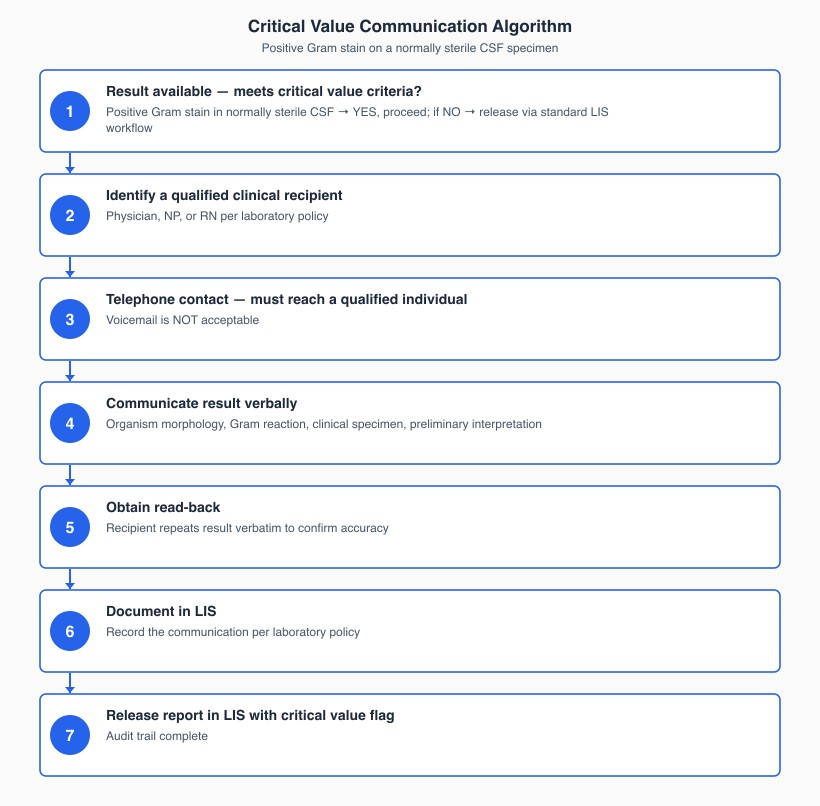
The pathway shown sets out how a positive cerebrospinal fluid Gram stain leaves the laboratory. A technologist has just read the smear and organisms are clearly present. Which report should be issued at that moment?
A physician who is not the requesting practitioner telephones the laboratory and asks for a patient's stool culture result before it has been released to the chart. What is the appropriate response?
Accounting for every request that entered the laboratory
A request that is accessioned but never resulted is invisible to the clinician, who assumes silence means the work is still in progress. Laboratories therefore reconcile received requests against issued reports every shift, using pending or outstanding-work listings. When an item appears on that list with no result, the technologist traces it physically: receiving bench, set-up area, incubators, instrument load lists and the discard bin. Only when the specimen genuinely cannot be found is the request cancelled and a recollection requested, and that cancellation is itself communicated rather than left silent.
At the end of a night shift the technologist compares the accession list against reports issued and finds a urine culture accessioned at 23:10 with no result recorded and no plate visible on the bench. What is the first action?
Passing specimens and findings to the right person
Some findings sit outside what a technologist may sign out alone. An isolate that will not key out on routine biochemicals, an unexpected organism from a sterile site, a gross parasite, or material that belongs to another discipline all need to move to a defined person: the charge technologist, the microbiologist, the pathologist or another section. Referral means handing over the material in a usable state — subcultured, retained and labelled — together with the observations already made, and documenting who took it. Holding an unresolved isolate on the bench until someone notices is the failure mode this area guards against.
A blood culture from a paediatric patient grows a Gram-positive bacillus that does not key out on the routine biochemical panel. The on-call microbiologist is available in the building. What should happen to the isolate?
A stool specimen submitted for ova and parasite examination contains an intact pale segmented worm fragment several centimetres long. The bench procedure covers concentrates and smears but says nothing about gross material. Where should this be directed?
Escalating quality failures and safety incidents
Quality and safety events are reported through a defined route, not settled informally between shifts. Missed turnaround targets, specimens left unprocessed, media used past expiry, incorrect patient identification, sharps injuries, spills and containment failures all generate an incident record that names what happened, when it was discovered and what was done immediately. The purpose is corrective action across the laboratory, not blame on an individual. A safety breach carries an added obligation: anyone who may have been exposed has to be identified and assessed, which cannot happen if the event is only noted in a maintenance log.
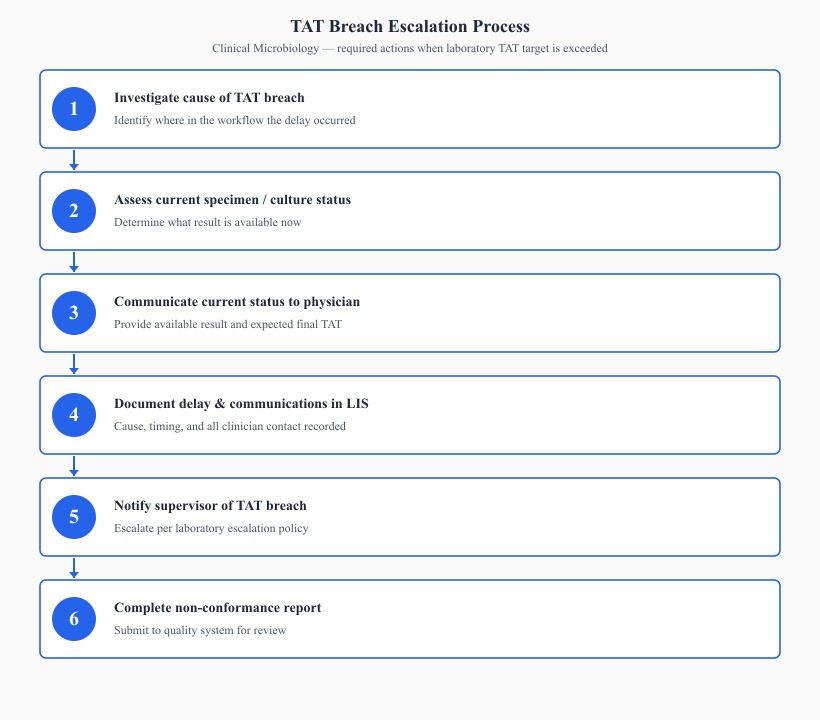
The escalation pathway shown is used when microbiology turnaround targets are missed. A flagged blood culture bottle is found still sitting in the receiving area six hours after it signalled, because it was never loaded onto the instrument. What does this pathway require of the technologist who finds it?
While subculturing broths a technologist notices that the biological safety cabinet airflow alarm has been silenced and the sash has been raised above the marked working line for the whole shift. The sash is lowered and the alarm restored. What else is required?
Notifying public health of reportable findings
Certain organisms carry an obligation that reaches past the ordering clinician. Provincial and territorial legislation lists diseases the laboratory itself must report — tuberculosis, invasive meningococcal and group A streptococcal disease, verotoxigenic Escherichia coli, Salmonella, Shigella, syphilis, gonorrhoea, measles and others — and for many of them the trigger is a laboratory finding rather than a clinical diagnosis. Notification is prompt, often on the smear or the presumptive result rather than the final one, and is usually paired with sending the isolate to the provincial laboratory for typing. The technologist reports to public health, not to schools, employers or families.
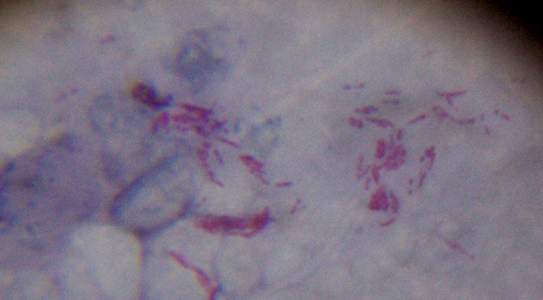
The stained sputum smear shown was prepared from a specimen sent by a community respiratory clinic and is read as positive. Beyond reporting to the requesting clinician, what does this finding oblige the laboratory to do?
A stool culture from a child attending a licensed daycare centre yields Shiga toxin-producing Escherichia coli O157. The requesting physician has already been telephoned with the result. What else is required of the laboratory?
Referring specimens and isolates to a reference laboratory
No single laboratory identifies everything. Suspected dimorphic fungi, mycobacteria beyond smear, rabies, viral haemorrhagic fever agents, rare parasites and unusual isolates go to a provincial or national reference laboratory, sometimes because the work needs containment level 3 and sometimes because the reference method exists nowhere else. Referral is a documented process: the culture or specimen is sealed and packaged to the transport rules for its risk group, the referral form records the clinical history and travel exposure that prompted it, and the pending request stays open in the sending laboratory until the reference result returns and is reported.
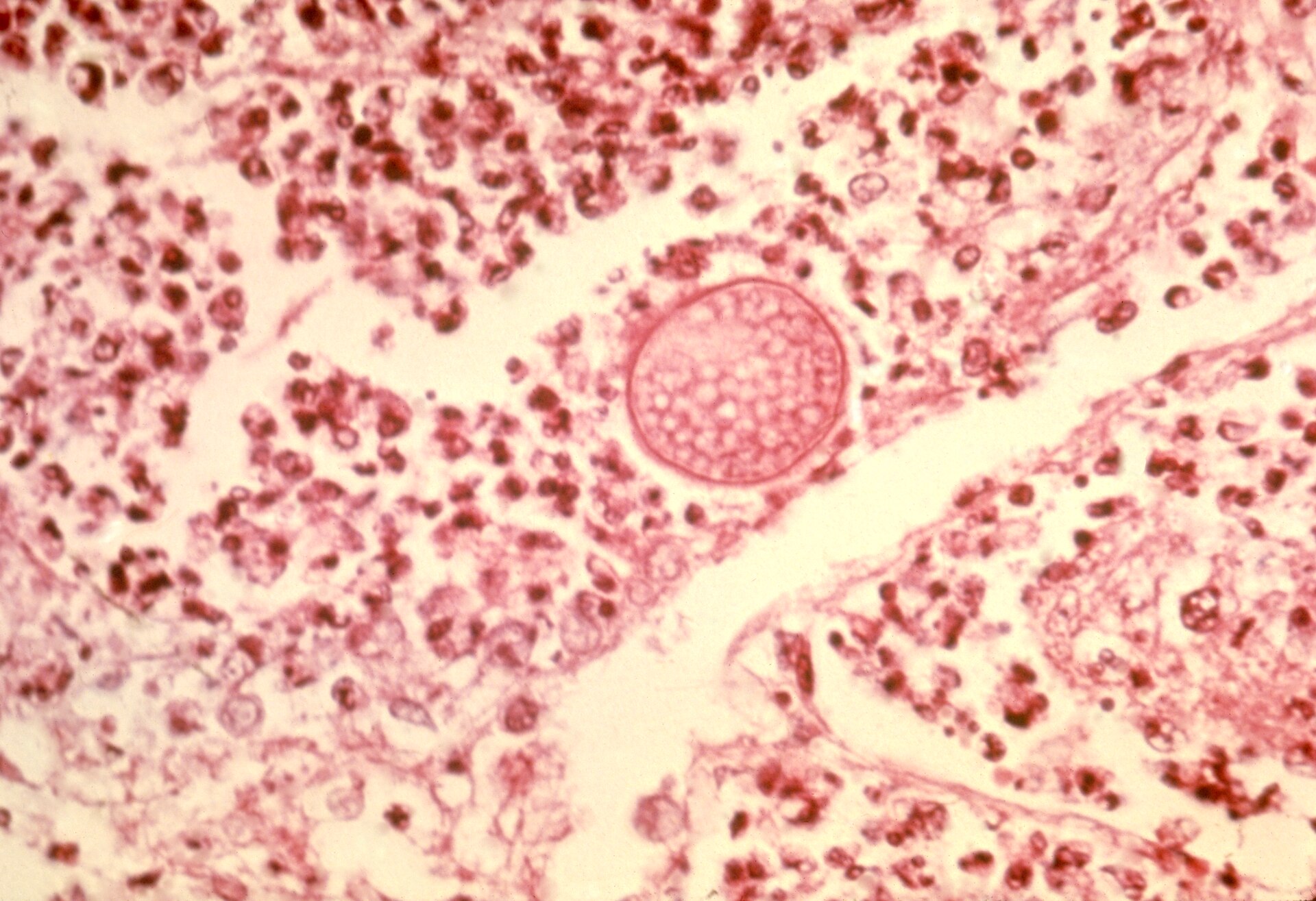
A lung tissue section from a patient with recent travel to the southwestern United States shows the structure pictured, and a culture from the same specimen is growing a white fluffy mould at room temperature. What should be done with that culture?
Keep reading with a free account
The rest of this page — 7 more sections and 12 practice questions — is free to read with an MLTPrep account.
No card required.
Back to all clinical microbiology areas in the Clinical Microbiology study guide.
MLTPrep is an independent study resource. Not affiliated with or endorsed by CAMLPR. Always confirm current requirements with CAMLPR directly.